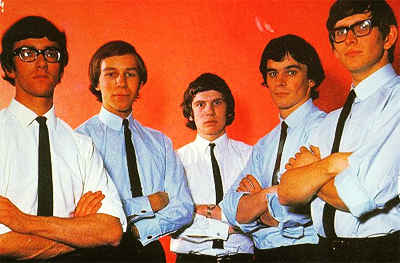
The Zombies
biography
Aside from the Beatles and
perhaps the Beach Boys, no mid-'60s rock group wrote melodies as gorgeous as
those of the Zombies. Dominated by Colin Blunstone's breathy vocals, choral
backup harmonies, and Rod Argent's shining jazz- and classical-influenced organ
and piano, the band sounded utterly unique for their era. Indeed, their
material -- penned by either Argent or guitarist Chris White, with unexpected
shifts from major to minor keys -- was perhaps too adventurous for the singles
market. To this day, they're known primarily for their three big hit singles,
"She's Not There" (1964), "Tell Her No" (1965), and
"Time of the Season" (1969). Most listeners remain unaware that the
group maintained a remarkably high quality of work for several years.
The Zombies formed in the
London suburb of St. Albans in the early '60s, and didn't actually entertain
serious professional ambitions until they won a local contest, the prize being
an opportunity to record a demo for consideration at major labels. Argent's
composition "She's Not There" got them a deal with Decca, and the
song ended up being their debut release. It was a remarkably confident and
original first-time effort, with a great minor melody and the organ, harmonies,
and urgent, almost neurotic vocals that would typify much of their work. It did
well enough in Britain (making the Top 20), but did even better in the States,
where it went to number two.
In fact, throughout their
career, the group would experience a lot more success across the waters than
they did at home. In early 1965, another piece of classic British Invasion pop,
"Tell Her No," went into the Top Ten. Yet that was as much Top 40
success as the group would have for several years. The tragedy was that
throughout 1965 and 1966, the Zombies released a string of equally fine,
intricately arranged singles that flopped commercially, at a time in which
chart success of 45s was a lot more important to sustain a band's livelihood
than it would be a few years down the road. "Remember When I Loved
Her," "I Want You Back Again," "Indication,"
"She's Coming Home," "Whenever You're Ready," "Gotta Get a Hold of Myself," "I Must Move,"
"Remember You," "Just Out of Reach," "How We Were
Before" -- all are lost classics, some relegated to B-sides that went
virtually unheard, all showing the group eager to try new ideas and expand
their approaches. What's worse, the lack of a big single denied the group
opportunities to record albums -- only one LP, rushed out to capitalize on the
success of "She's Not There," would appear before 1968.
Their failure to achieve more
widespread success is a bit mystifying, perhaps explained by a few factors. While
undeniably pop-based, their original compositions and arrangements were in some
senses too adventurous for the radio. "Indication," for instance,
winds down with a lengthy, torturous swirl of bitter organ solos and wordless,
windblown vocals; "Remember When I Loved Her," despite its beautiful
melody, has downbeat lyrics that are almost morbid; "I Want You Back
Again" is arranged like a jazz waltz, with the sorts of sudden stops,
tempo shifts, and lengthy minor organ solos found in a lot of their tunes. The Zombies
were also, perhaps unfairly, saddled with a somewhat square image; much was
made of their formidable scholastic record, and they most definitely did not
align themselves with the R&B-based school of British bands, preferring
more subtle and tuneful territory.
By 1967, the group hadn't had
a hit for quite some time, and reckoned it was time to pack it in. Their Decca
contract expired early in the year, and the Zombies signed with CBS for one
last album, knowing before the sessions that it was to be their last. A limited
budget precluded the use of many session musicians, which actually worked to
the band's advantage, as they became among the first to utilize the then-novel Mellotron to emulate strings and horns.
Odessey and Oracle was their
only cohesive full-length platter (the first album was largely pasted together
from singles and covers). A near-masterpiece of pop/psychedelia,
it showed the group reaching new levels of sophistication in composition and
performance, finally branching out beyond strictly romantic themes into more
varied lyrical territory. The album passed virtually unnoticed in Britain, and
was only released in the States after some lobbying from Al Kooper. By that
time it was 1968, and the group had split for good.
The Zombies had been defunct
for some time when one of the tracks from Odessey, "Time of the
Season," was released as a single, almost as an afterthought. It took off
in early 1969 to become their biggest hit, but the members resisted temptations
to re-form, leading to a couple of bizarre tours in the late '60s by bogus
"Zombies" with no relation to the original group. By this time, Rod
Argent was already recording as the leader of Argent, which went in a harder
rock direction than the Zombies. After a spell as an insurance clerk, Colin
Blunstone had some success (more in Britain than America) in the early '70s as
a solo vocalist, with material that often amounted to soft rock variations on the
Zombies
Much more influential than
their commercial success would indicate, echoes of the Zombies' innovations can
be heard in the Doors, the Byrds, the Left Banke, the
Kinks, and many others. After a long period during which most of their work was
out of print, virtually all of their recordings have been restored to
availability on CD. Blunstone and Argent reunited for an album, Out of the
Shadows, and toured together in 2003 as Blunstone & Argent, playing live
shows into 2004 when they began gigging again as the Zombies,
with an album and DVD set, Live at the Bloomsbury Theatre, appearing under that
name in 2005. To honor the 40th anniversary of Odessey
and Oracle, the four surviving original members of the group reunited for a
series of three concerts at London's Shepherd's Bush Empire Theatre in March of
2008, with a CD and DVD set of the shows hitting the market later that summer. A
new studio album, Breathe Out, Breathe In, attributed to the Zombies featuring
Colin Blunstone & Rod Argent, appeared in 2011.