Hank Williams biography
Born in Mount Olive West,
At 16, living in Montgomery, Williams quit
school and began his music career in earnest. He made his first radio
appearance on WSFA in late 1936 or early 1937 and soon became one of the
station's most popular performers. He also worked beer joints and regional
shows with his band, already named the Drifting Cowboys. Lillie drove the group
to venues in her station wagon and collected gate money. By the early '40s,
Hank was one of the biggest draws in the region and had come to the attention
of several
In 1943 Hank met Audrey Mae Sheppard, an
two-year-old daughter,
Lycrecia, from a failing marriage. Audrey learned to play stand-up bass, well enough anyway, to play in
the band, and began acting as manager. Audrey and Hank were married in December
1944. She desperately craved a singing career, pushing for inclusion in the
show at every chance. Her ambition, however, far exceeded her talent. Audrey
would vie with Lillie for Hank's attention throughout the relationship. In 1946
she accompanied her husband to
Rose, in a partnership with Roy Acuff, ran a successful "hillbilly" publishing
concern (Acuff-Rose, later a giant in the industry)
and at first was interested in Williams only as a writer. (Hank had begun
writing songs shortly after he started singing and
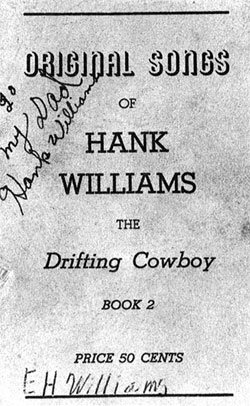
playing guitar and sold songbooks at his club appearances.) Within the year,
however, Rose had made Hank's singing career a pet project and arranged for him
to record four songs for the
In March 1947, in a deal engineered by
Rose, Hank signed with MGM. "Move It On Over" was his first MGM
release and his first Billboard chart entry. He charted again in April
1948, with "Honky Tonkin." Back home in
Williams was bottoming out.
Hank's story could
easily could have ended there, but the Williams reconciled, the
relationship with Rose was mended, and Rose set about finding an avenue for
greater exposure for Williams. Decision makers at the Opry
were still wary, but KWKH in
Nearly 50 years later, in a world where
today's icon is tomorrow's
inconsequential, it is difficult to
imagine a song so igniting radio listeners that it holds the top spot on the
charts for sixteen weeks. No one in Hank's circle wanted him to waste time or
tape on "Lovesick Blues." The song was a throwaway, they said; a
piece of fluff that was more likely to damage his career than enhance it. Hank
was insistent, though, and the song was given two quick passes at the end of a
session. Released in February 1949, it was No. 1, and more, by early May. "Lovesick
Blues" was an "event;" popular beyond precedent, imagination or
belief. And suddenly, Hank Williams was big. Big enough at
last for the Opry.
With success came increased creative
freedom. Hank's "mainstream" songwriting
and recording efforts continued to do extremely well, but he also delved into
remorseful gospel themes and a series of recitations under the transparent
pseudonym "Luke the Drifter." Hank the writer often seemed
preoccupied with mortality and the
futility of human relationships, his marriage to Audrey was now in steady decline,
and those who knew him could easily see the real-life parallels in songs like
"You're Gonna Change (Or I'm Gonna
Leave)" and "Cold, Cold Heart." Clearly, here was a man
displaying his demons for all to see. Hank didn't have to "interpret"
sad songs; he had only to sing from his heart.
For a time, fame and fortune staved off
the consequences of his self-destructive lifestyle. By mid-1952, however, his
life was coming apart at the seams. Wracked with back pain, he was dependent on
alcohol and, it is believed, morphine. Often missing or too drunk to perform at
curtain time, he was fired by the Opry. Audrey again
filed for divorce, and Hank headed back to
Three of Hank's recordings reached the top
of the charts in the year following his death. By 1954, his earthly voice
silenced, the fragile young man from