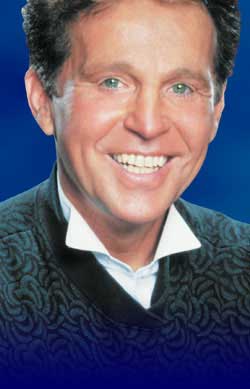
Bobby Vinton
biography
Every era needs its crooner, and in the
early '60s, it was Bobby Vinton. Vinton's sentimental balladeering
and orchestral, middle-of-the-road arrangements were a throwback to a decade
earlier, before rock & roll had found its mass market. If Vinton is
sometimes identified with a rock & roll audience, it's only because his
music was bought by young listeners for a time, and because he still catches
some airplay on oldies stations. What he sang was vocal pop, landing some of
the biggest hits of the early '60s with "Roses Are Red (My Love),"
"Blue on Blue," "There! I've Said It Again," "Mr.
Lonely," and "Blue Velvet," the last of which has become his
signature song in the wake of its notorious prominence in David Lynch's Blue Velvet.
Vinton originally aspired to lead a big band, and made
big band versions of contemporary hits on his first recordings in the early
'60s. When he began singing, however, he was quickly successful, reaching
number one with "Roses Are Red (My Love)" in mid-1962. The syrupy,
saccharine arrangements set the mold for his
emotional, occasionally mournful hits throughout the early '60s. 1963 was his
banner year, as he hit number three with "Blue on Blue," and then
topped the charts with "Blue Velvet" and "There! I've Said It
Again."
"There! I've Said It Again" was knocked out
of the number one spot by the Beatles' "I Want to Hold Your Hand."
But the British Invasion, surprisingly, didn't spell commercial death for
Vinton, as it did for so many other balladeers and teen idols. Indeed, he had
one of his biggest hits (and his final number one), the sobbing "Mr.
Lonely," in late 1964. Although he didn't maintain quite the same
superstar ranking, he was consistently popular throughout the next decade;
between 1962 and 1972, in fact, he had an astonishing 28 Top 40 entries. Often
he updated quaint 1960-era pop tunes such as "Halfway to
Vinton seemed to have launched a major comeback in
1974 with "Melody of Love," which made number three, and enjoys the
distinction of being the only major American hit single sung partially in
Polish. Only one more Top 40 hit was in the offing, though. This probably
didn't particularly bother Vinton, who had his own TV series for a few years in
the late '70s, and could always count on lucrative gigs on the cabaret circuit.