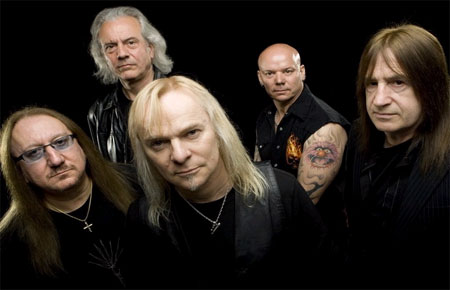
Uriah Heep biography
Uriah Heep's by-the-books
progressive heavy metal made the British band one of the most popular hard rock
groups of the early '70s. Formed by vocalist David Byron and guitarist Mick Box
in the late '60s, the group went through an astonishing number of members over
the next two decades -- nearly 30 different musicians passed through the band
over the years. Byron and Box were members of the mid-'60s rock band called the
Stalkers; once that band broke up, the duo formed another group called Spice. Spice
would eventually turn into Uriah Heep
in the late '60s, once Ken Hensley (guitar, keyboards, vocals)
and bassist Paul Newton joined the pair. Former Spice drummer Alex Napier was
the band's drummer for a brief time; he was quickly replaced by Nigel Olsson.
Uriah Heep released their debut album Very 'eavy...Very 'umble (called Uriah Heep in the U.S.) in 1970. After
its release, Keith Baker became the group's drummer; he recorded Salisbury, the
group's second album, before deciding he couldn't keep up with the band's
extensive touring and was replaced by Ian Clarke. Salisbury, featuring a
16-minute title track recorded with a 26-piece orchestra, showcased the band's more
progressive tendencies. Later that year, Ian Clarke was replaced by Lee Kerslake and Mark Clarke replaced Newton; Mark Clarke
quickly left the band and Gary Thain became the
group's bassist. This lineup of Uriah
Heep was its most stable and popular; beginning with
1972's Demons and Wizards, they released five albums between 1972 and 1975.
After 1975, the band's popularity began to slip. Byron
left the band in 1977 and was replaced by John Lawton, yet the group's fortunes
kept declining right into the early '80s. However, Uriah
Heep soldiered on, continuing to release albums into
the '90s and 2000s. The album roster included Different World (1994), Sea of
Light (1995), Sonic Origami (1998), and Spellbinder (1999).