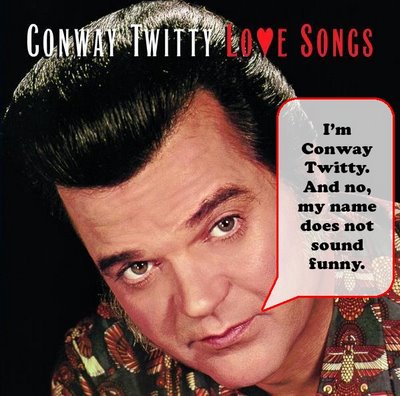
Conway Twitty biography
Conway Twitty was born Harold
Jenkins on Sept. 1, 1933, in the small town of Friars Point, Miss. His father,
a riverboat pilot, taught him his first guitar chords when Conway was just 4
years old. From a black church in the town, he heard the sounds of gospel, and
every Saturday night the family gathered around the radio for the Grand Ole
Opry.
His family moved to Helena, Ark., when he was 10, and there he put
together his first band, the Phillips County Ramblers. Two years later, he had his own local radio show every
Saturday morning. While in Arkansas, Twitty indulged his second passion --
baseball. He received an offer to play with the Philadelphia Phillies after
high school but joined the Army instead.
After his discharge from the Army, Twitty again pursued a music career. After hearing Elvis Presley's "Mystery
Train," he began writing original rock 'n' roll material. As a matter of
course, he headed for the Sun Studios in Memphis, Tenn., and worked with the
likes of Presley, Carl Perkins, Jerry Lee Lewis, Johnny Cash and many others.
He changed his name in 1957, taking the names from two towns in
Arkansas. However, Twitty didn't try
rockabilly like some of his cohorts. Instead, he scored his first hit with a
teen ballad, "It's Only Make Believe," on MGM in 1958, making him a
teen idol of the day.
Eight years and three gold records later, he began his country career
with MCA/Decca in 1965, and by the early '70s, he had scored four straight No.
1 hits including "Hello Darlin'." Many
of them, featuring his signature growling vocal style, especially endeared him
to female listeners.
In 1971, he released his first hit duet with Loretta Lynn, "After
the Fire Is Gone," followed by "Lead Me On" in 1971,
"Louisiana Woman, Mississippi Man" in 1973 and "As Soon As I
Hang Up the Phone" in 1974. Together,
they won four consecutive CMA awards for vocal duo, but Twitty never won a solo
CMA award. Yet, by the end of his tenure at MCA in 1981, he had accumulated 32
No. 1 hits. Another 15 had reached the Top 5.
In 1982, Twitty moved to
Warner Bros. (then Elektra) and reached No. 1 with remakes of the Pointer
Sisters' "Slow Hand" and Bette Midler's "The Rose." In
1987, he returned to MCA, where he co-produced his albums with his wife, Dee
Henry. The hits, such as "Julia" and "That's My Job"
continued.
Twitty became ill while
performing in Branson, Mo., and he died on June 5, 1993, from an abdominal
aneurysm. Shortly before he died, he had recorded a new album, suitably called
Final Touches.
He was inducted into the Country Music Hall of Fame in 1999.