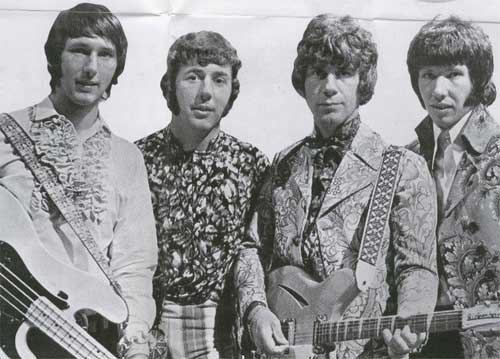
The Tremeloes biography
When UK
chart-toppers Brian Poole And The Tremeloes parted
company in 1966 few would have wagered that the backing group would outdo the
lead singer. Remarkably, however, the relaunched Tremeloes went on to eclipse not only Poole,
but the original hit-making act. At the time of their reconvening in 1966, the
line-up comprised Rick West (b. Richard Westwood, 7 May 1943, Dagenham, Essex, England;
guitar), Alan Blakley (b. 1 April 1942, Dagenham, Essex, England,
d. 1995; rhythm guitar), Dave Munden (b. 2 December
1943, Dagenham, Essex, England; drums) and Alan Howard (b. 17 October
1941, Dagenham, Essex, England; bass). In May of 1966
Howard was replaced by Mike Clark; however, a mere three months later his spot
was taken by Len "Chip" Hawkes (b. 11 November
1946, London, England), whose lead vocals and boyish looks gave the group a
stronger visual identity. In order to keep up with the times, the group
abandoned their stage suits in favour of Carnaby Street
garb and fashionably longer hair. Their second generation debut for Decca
Records was a cover of Paul Simon's "Blessed", which proved
unsuccessful. Seeking more commercial material they moved to CBS Records and
covered "Good Day Sunshine" from the Beatles' Revolver. In spite of
radio play it too failed to chart, but their third release "Here Comes My
Baby" (a Cat Stevens composition) smashed into the Top 20 on both sides of
the Atlantic.
An astute follow-up with "Silence Is Golden", previously the
flip-side of the Four Seasons' "Rag Doll', proved a perfect vehicle for
the Tremeloes" soft harmonic style and gave them
their only UK number 1 and
their highest US
chart entry (number 11). Having established themselves as a hit act, they
notched up an impressive run of hits during the late 60s including "Even The Bad Times Are Good", "Suddenly You Love
Me", "Helule Helule"
and "My Little Lady". At the end of the decade, the group seemed
weary of their role in the pop world and broke away from their usual Tin Pan
Alley songsmiths to write their own material. Their first attempt, "(Call
Me) Number One", was an impressive achievement, arguably superior to the
material that they had recorded since 1967. When it reached number 2 in the
charts, the group convinced themselves that a more ambitious approach would bring
even greater rewards. Overreacting to their dream start as hit writers, they
announced that they were "going heavy" and suicidally
alienated their pop audience by dismissing their earlier record-buying fans as
"morons".
Their brief progressive phase was encapsulated in the album Master, which won
no new fans but provided a final Top 20 single, "Me And
My Life". Thereafter, they turned increasingly to cabaret where their
strong live performances were well appreciated. In 1974 Chip Hawkes went to Nashville,
USA, to pursue
an ultimately unsuccessful solo career (his son Chesney
Hawkes would enjoy a brief moment in the spotlight in
the late 80s). Blakley left the following January,
and Aaron Woolley and Bob Benham
were brought in as replacements. The Tremeloes
continued to record on an occasional basis, with
albums being released by DJM Records and their old label CBS. They were still
active in the new millennium, with Munden and West
joined by Joe Gillingham (keyboards/vocals) and Davey Freyer (bass/vocals).