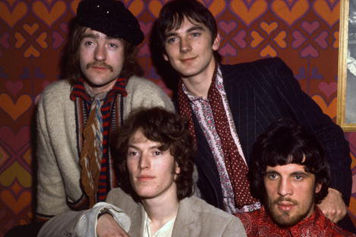
Traffic biography
Though it ultimately must be
considered an interim vehicle for singer/songwriter/keyboardist/guitarist Steve
Winwood, Traffic was a successful group that followed
its own individual course through the rock music scene of the late '60s and
early '70s. Beginning in the psychedelic year of 1967 and influenced by the
Beatles, the band early on turned out eclectic pop singles in its native Great
Britain, though by the end of its first year of existence it had developed a
pop-rock hybrid tied to its unusual instrumentation: At a time when electric
guitars ruled rock, Traffic emphasized Winwood's
organ and the reed instruments played by Chris Wood, especially flute.
After Dave Mason, who had provided
the band with an alternate folk-pop sound, departed for good, Traffic leaned
toward extended songs that gave its players room to improvise in a jazz-like
manner, even as the rhythms maintained a rock structure. The result was
international success that ended only when Winwood
finally decided he was ready to strike out on his own.
Steve Winwood
(born May 12, 1948) first attracted attention when, at the age of 15, he and
his older brother Muff formed a band in their native Birmingham, England, with
Spencer Davis and Pete York, eventually called the Spencer Davis Group. They
were signed by record executive Chris Blackwell, founder of Island Records, and
began recording in 1964. As the band's vocalist, Winwood
received the lion's share of attention. By the time he and his brother quit the
group in April 1967, the Spencer Davis Group had amassed four Top Ten singles
and three Top Ten albums in the U.K., two of those singles also reaching the
Top Ten in the U.S.
Still not yet 19 years old, Winwood formed Traffic with three 22-year-old friends who
had played in lesser-known bands - drummer/singer Jim Capaldi
(August 24, 1944 - January 28, 2005), singer/guitarist Mason (born May 10,
1944), and Wood (June 24, 1944 - July 12, 1983). In the spirit of the times
(and despite Winwood's prominence), the group was intended
to be a cooperative, with the members living together in a country cottage in
Berkshire and collaborating on their songs. Blackwell quickly signed them and
released their debut single, "Paper Sun," which peaked in the U.K.
Top Five in July 1967 and also spent several weeks in the lower reaches of the
charts in America, where Blackwell licensed it to United Artists Records, as he
had the Spencer Davis Group's recordings.
Meanwhile, as Traffic recorded material
for its debut album during the summer of 1967, its communal outlook was
disrupted by Mason, who, unlike Winwood (a composer
who needed help with lyrics and therefore tended toward collaboration), was
capable of writing songs on his own and did so. The success of "Paper
Sun" encouraged Blackwell to release a follow-up single quickly, and he
chose as the most likely candidate among the songs Traffic had recorded so far
"Hole in My Shoe," written and sung by Mason. It became an even
bigger hit than "Paper Sun," almost topping the British charts in October,
but that didn't sit well with Winwood, who felt it
was unrepresentative of the sound he wanted for Traffic. The group's third
single was "Here We Go Round the Mulberry Bush," the title song from
a motion picture, which became their third British Top Ten hit in December, the
same month that their debut album, Mr. Fantasy, was released. It, too, earned a
Top Ten ranking in January 1968, but by then Mason had left Traffic. A fourth
single, "No Face, No Name, No Number," culled from the album, made
the British Top 40 in March, the month that Traffic debuted as a live
attraction in the U.S., where Mr. Fantasy (initially titled Heaven Is in Your
Mind) reached the Top 100.
Traffic was released in October 1968, and
the band went on tour in the U.S. to promote it. But just after the start of
the tour, Winwood, Capaldi,
and Wood fired Mason. Then, at the conclusion of the tour, Winwood
withdrew, announcing the breakup of Traffic at the beginning of 1969. These
events notwithstanding, the album reached the U.K. Top Ten and the U.S. Top 20.
And breakup or no, Winwood was contracted to Island
and United Artists for five albums, of which only two had been delivered. Thus,
in April 1969, the labels released Last Exit, a collection of non-LP singles
sides, outtakes, and live recordings. It was another Top 20 success in America.
The 1967-1974-era band continued to enjoy
significant status as a classic rock act, its albums earning CD reissues along
with the release of compilations like Smiling Phases (1991) and Feelin' Alright: The Very Best of Traffic (2000). Capaldi's death on January 28, 2005, appeared to put an end
to the band.