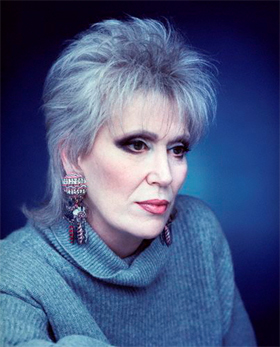
Dusty Springfield biography
Britain's
greatest pop diva, Dusty Springfield was also the finest white soul singer of
her era, a performer of remarkable emotional resonance whose body of work spans
the decades and their attendant musical transformations with a consistency and
purity unmatched by any of her contemporaries; though a camp icon of glamorous
excess in her towering beehive hairdo and panda-eye black mascara, the sultry
intimacy and heartbreaking urgency of Springfield's voice transcended image and
fashion, embracing everything from lushly orchestrated pop to gritty R&B to
disco with unparalleled sophistication and depth.
She
was born Mary O'Brien on April 16, 1939, and raised on an eclectic diet of
classical music and jazz, coming to worship Peggy Lee; after completing her
schooling she joined the Lana Sisters, a pop vocal trio which issued a few
singles on Fontana before dissolving. In 1960, upon teaming with her brother
Dion O' Brien and his friend Tim Feild in the folk
trio the Springfields, O'Brien adopted the stage name
Dusty Springfield; thanks to a series of hits including "Breakaway,"
"Bambino," and "Say I Won't Be There," the group was soon
the U.K.'s best-selling act.
After the Springfields cracked the U.S. Top 20 in 1962 with
"Silver Threads and Golden Needles," the group traveled
stateside to record in Nashville, where exposure to the emerging American
girl-group and Motown sounds impacted Dusty so
profoundly that in 1963 she left the Springfields at
the peak of their fame to pursue a solo career. Her first single, "I Only
Want to Be With You," boasted a dramatic sound and soulful melody worthy
of a Phil Spector hit, and it quickly reached the
British Top Five; it also fell just shy of the Top Ten in the U.S., where it
became the first major record from a U.K. act other than the Beatles since the Fab Four's launch of the British Invasion. Her biggest
American Top Ten hit, "Wishin' and Hopin'," was the first in a series of Springfield
smashes from the pen of songwriters Burt Bacharach and Hal David.
Additionally
charting with hits including "Stay Awhile" and "All Cried
Out," by the end of 1964 Springfield was arguably the biggest solo act in
British pop, winning the first of four consecutive Best Female Vocalist honors in NME; that same year, she also created a political
furor after she was deported from South Africa for
refusing to play in front of racially segregated audiences.
In 1966, she
scored her biggest international hit with the devastating ballad "You
Don't Have to Say You Love Me," which topped the U.K. charts and reached
the Top Five in the U.S. The soundalike "All I
See Is You," another heart-wrenching evocation of unrequited love, soon
reached the British Top Ten as well; it was followed, however, by the
Bacharach/David-penned "The Look of Love," a bossa
nova-inflected classic positively radiating with dreamlike sensuousness.
By 1968,
however, Springfield's commercial fortunes were on the decline -- in the wake
of Sgt. Pepper and the Summer of Love, "girl singers" were now widely
perceived as little more than fluff. In response, she signed to the American
label Atlantic, traveling to Memphis to record with
producers Jerry Wexler, Tom Dowd, and Arif Mardin; the resulting album, issued in early 1969 as Dusty
in Memphis, remains her masterpiece, a perfect marriage of pop and soul
stunning in its emotional complexity and earthy beauty. Although the classic
single "Son of a Preacher Man" cracked the Top Ten on both sides of
the pond, the album itself was nevertheless a commercial failure, as was its
fine 1970 follow-up, A Brand New Me.
Apart from
singing backup on Anne Murray's Together album, Springfield spent the mid-'70s
outside of music while battling substance abuse problems. She finally resurfaced
in 1978 with the Roy Thomas Baker-produced It Begins Again, followed a year
later by Living Without Your Love; both attracted little notice, although the
non-album single "Baby Blue" was a minor British hit in 1979. Apart
from a handful of soundtrack contributions, Springfield was silent until
returning to London in 1982 to record White Heat, an album firmly grounded in
the prevailing synth-pop sound of its times; again,
despite good critical notices, a comeback failed to materialize. She would release
just a handful of singles over the next few years, including the 1984 Spencer
Davis duet "Private Number," the 1985 ballad "Sometimes Like Butterflies," and a 1987 collaboration with
Richard Carpenter, "Something in Your Eyes," which became a minor success
in the U.S.
Upon
returning to California in 1987, Springfield was contacted to collaborate with
techno-pop innovators the Pet Shop Boys on a duet titled "What Have I Done
to Deserve This?" The single was a global
blockbuster, peaking at number two in both the U.S. and the U.K., and it
introduced her to a new generation of listeners; Pet Shop Boys Neil Tennant and
Chris Lowe also agreed to produce a handful of tracks for 1990's Reputation,
which became Springfield's best-selling new album since her '60s-era peak. The
follow-up, 1995's country-influenced A Very Fine Love, was recorded in
Nashville; during sessions for the album, she was diagnosed with breast cancer,
and after months of radiation therapy the illness was believed to be in
remission. By the summer of 1996, however, the cancer had returned, and on
March 2, 1999, Springfield died at the age of 59; just ten days later, she was
inducted into the Rock and Roll Hall of Fame.