Marty Robbins biography
No artist in the history of country music
has had a more stylistically diverse career than Marty Robbins. Never content
to remain just a country singer, Robbins performed successfully in a dazzling
array of styles during more than 30 years in the business. To his credit,
Robbins rarely followed trends but often took off in directions that stunned
both his peers and fans. Plainly Robbins was not hemmed in by anyone's
definition of country music. Although his earliest recordings were unremarkable
weepers, by the mid-'50s Robbins was making forays into rock music, adding
fiddles to the works of Chuck Berry and Little Richard. By the late '50s,
Robbins had pop hits of his own with teen fare like "A White Sport Coat
(And a Pink Carnation)." Almost simultaneously, he completed work on his
Song of the Islands album. In 1959, Robbins
stretched even further with the hit single "El Paso," thus heralding a pattern of
"gunfighter ballads" that lasted the balance of his career. Robbins
also enjoyed bluesy hits like "Don't Worry," which introduced a pop
audience to fuzz-tone guitar in 1961. Barely a year later, Robbins
scored a calypso hit with "Devil Woman." Robbins also left a legacy
of gospel music and a string of sentimental ballads, showing that he would
croon with nary a touch of hillbilly twang.
Born and raised in Glendale, AZ,
Robbins (born Martin David Robertson, September 26, 1925; died December 8,
1982) was exposed to music at an early age. His mother's father was "Texas" Bob Heckle,
a former medicine show man who told his grandson cowboy stories and tales of
the traveling show. Robbins became enraptured by the
cowboy tales and, once he became a teenager, worked on his older brother's
ranch outside of Phoenix,
concentrating more on his cowboy duties than his studies. Indeed, he never
graduated from high school, and by his late teens, he started turning petty
crimes while living as a hobo. In 1943, he joined the U.S. Navy to fight in
World War II, and while he was in the service, he learned how to play guitar
and developed a taste for Hawaiian music. Robbins left the Navy in 1947,
returning to Glendale,
where he began to sing in local clubs and radio stations. Often, he performed
under the name "Jack Robinson" in an attempt to disguise his endeavors from his disapproving mother. Within three years,
he had developed a strong reputation throughout Arizona
and was appearing regularly on a Mesa radio
station and had his own television show, Western Caravan, in Phoenix. By that time, he had settled on the
stage name of Marty Robbins.
Robbins landed a recording contract with Columbia in 1951 with the
assistance of Little Jimmy Dickens, who had been a fan ever since appearing on
Western Caravan. Early in 1952, Robbins released his first single, "Love
Me or Leave Me Alone." It wasn't a success and neither was its follow-up,
"Crying 'Cause I Love You," but "I'll Go On Alone" soared
to number one in January 1953. Following its blockbuster success, Robbins
signed a publishing deal with Acuff-Rose and joined the
Grand Ole Opry. "I Couldn't Keep From
Crying" kept him in the Top Ten in spring 1953, but his two 1954 singles
-- "Pretty Words" and "Call Me Up (And I'll Come Calling on
You)" -- stalled on the charts. A couple of rock & roll covers,
"That's All Right" and "Maybellene,"
returned him to the country Top Ten in 1955, but it wasn't until "Singing
the Blues" shot to number one in fall 1956 that Robbins' career was truly
launched. Staying at number one for a remarkable 13 weeks, "Singing the
Blues" established Robbins as a star, but its progress on the pop charts
was impeded by Guy Mitchell's cover, which was released shortly after Robbins'
original and quickly leapfrogged to number one. The process repeated itself on
"Knee Deep in the Blues," which went to number three on the country
charts but didn't even appear on the pop charts due to Mitchell's hastily
released cover. To head off such competition, Robbins decided to record with
easy listening conductor Ray Conniff for his next
singles. It was a crafty move and one that kept him commercially viable during
the peak of rock & roll. The first of these collaborations, "A White
Sport Coat (And a Pink Carnation)," became a huge hit, spending five weeks
at the top of the country charts in spring 1957 and peaking at number two on
the pop charts, giving him his long-awaited breakthrough record.
After "A White Sport Coat (And a Pink
Carnation)," Robbins was a regular fixation on both the pop and country
charts until the mid-'60s. The Burt Bacharach and Hal David composition
"The Story of My Life" returned Robbins to the number one country
slot in early 1957 (number 15 pop), while "Just Married,"
"Stairway of Love," and "She Was Only Seventeen (He Was One Year
More)" kept him in teen-pop territory, as well as the upper reaches of the
charts, throughout 1958. In addition to his pop records, Robbins recorded
rockabilly singles and Hawaiian albums that earned their own audience. During
that time, he began a couple of business ventures of his own, including a
booking agency and a record label called Robbins. He also ventured into movies,
appearing in the Westerns Raiders of Old California (1957) and Badge of Marshal
Brennan (1958), where he played a Mexican named Felipe. The films not only
demonstrated Robbins' love for Western myths and legends, but they signalled
the shift in musical direction he was about to take. Over the course of 1958
and 1959, he recorded a number of cowboy and western songs, and the first of
these -- "The Hanging Tree," the theme to the Gary Cooper film of the
same name -- became a hit in spring 1959. However, the song just set the stage
for Robbins' signature song and biggest western hit, "El Paso." Released in the summer, the
single spent six months on the country charts, including seven weeks at number
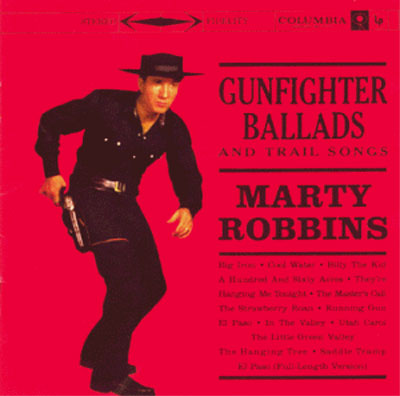
one, while hitting the top of the pop charts. A full album of western songs,
Gunfighter Ballads and Trail Songs, became equally successful, reaching number
six on the pop charts, and by the mid-'60s, it had gone platinum.
"El Paso"
began a very successful decade for Robbins. "Big Iron," another
western song, followed its predecessor to the Top Ten of the country charts in
1960, but it wasn't until 1961 that he had another huge hit in the form of
"Don't Worry." Fueled by a fuzz-toned
guitar (the first country record to feature such an effect), "Don't
Worry" spent ten weeks at number one and crossed over to number three on
the pop charts. The following year, "Devil Woman" became nearly as
successful, spending eight weeks at number one; it was followed by another
number one, "Ruby Ann." Between "Don't Worry" and
"Devil Woman," he had a number of smaller hits, most notably the Top
Ten "It's Your World," and for the rest of
the decade, his biggest hits alternated with more moderate successes. With his
career sailing along, Robbins began exploring racecar
driving in 1962, initially driving in dirt-track racing competitions before
competing in the famous NASCAR race. However, car racing was just a hobby, and
he continued to have hits in 1963, including the number one "Begging to
You." The following year, he starred in the film Ballad of a Gunfighter,
which was based on songs from his classic album.
Robbins' chart success continued throughout 1964,
before suddenly dipping after he took Gordon Lightfoot's "Ribbon of
Darkness" to number one in spring 1965. For the remainder of the year and
much of the next, his singles failed to crack the Top Ten, and he concentrated
on filming a television series called The Drifter, which was based on a
character he had created. He also acted frequently, including the Nashville exploitation
films Country Music Caravan, The Nashville Story, and Tennessee Jamboree and
the stock-car drama Hell on Wheels. Though "The Shoe Goes on the Other
Foot Tonight" reached number three in 1966, it wasn't until "Tonight
Carmen" reached number one on the country charts in 1967 that his career
picked up considerably. During the next two years, he regularly hit the Top Ten
with country-pop songs like "I Walk Alone" and "It's a
Sin." Robbins suffered from a heart attack while on tour in August 1969,
which led to a bypass operation in 1970. Despite his brush with death, he
continued to record, tour, and act. Early in 1970, "My Woman My Woman My
Wife" became his last major crossover hit, reaching number one on the
country charts and 42 on the pop charts and eventually earning a Grammy award.
Robbins left Columbia Records in 1972, spending the
next three years at Decca/MCA. Though "Walking Piece of Heaven,"
"Love Me," and "Twentieth Century Drifter" all reached the
Top Ten, most of his singles were unenthusiastically received. Nevertheless, he
sustained his popularity through concerts and film appearances, including the
Lee Marvin movie A Man and a Train and Guns of a Stranger. In March 1974,
Robbins became the last performer to play at the Ryman Auditorium, the original
location of the Grand Ole Opry; a week later, he was
the first to play at the new Grand Ole Opry House. The
honors and tributes to Robbins continued to roll out
during the mid-'70s, as he was inducted into Nashville Songwriters
International Hall of Fame in 1975. That same year, he returned to Columbia
Records, and over 1976 and 1977 he had his last sustained string of Top Ten
hits, with "El Paso
City" and
"Among My Souvenirs" reaching number one. Following this two-year
burst of success, Robbins settled into a series of minor hits for the next four
years. In October 1982, he was inducted into the Country Music Hall of Fame. Two
months later, he suffered his third major heart attack (his second arrived in
early 1981), and although he had surgery, he died on December 8. In the wake of
his death, his theme song to Clint Eastwood's movie Honky Tonk
Man was released and climbed to number ten. Robbins left behind an immense
legacy, including no less than 94 charting country hits and a body of recorded
worked that proved how eclectic country music could be.