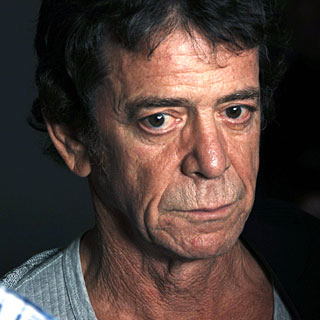
Lou Reed biography
IN his childhood, Lou Reed longed to play
rock and roll — a common dream, perhaps, but Reed was different. By his teens,
he had learned to play guitar, had made his first record, had alienated his
suburban parents, and had been subjected to electro-shock therapy. During these
years, Reed's parents insisted that he take typing lessons so that he would
develop a saleable skill, but that didn't seem to cure him of his rock and roll
aspirations.
As much as he could, Reed tried to live the straight and narrow: he went to
college at Syracuse University in New York; he joined the R.O.T.C. (he was
kicked out for threatening to shoot an officer); after graduating, he took a
post with Pickwick Records as a staff songwriter, and tried to pen Top 10 hits.
But he never seemed to fit with the program — even as a songwriter. He realized
that cookie-cutter hit writing was not his rock-and-roll dream, and in 1965, he
and another staff writer, John Cale, formed a band
called the Warlocks. As quickly as they added members, they changed band names:
in the space of one year, they became "The Primitives," "The
Falling Spikes," and, finally, "The Velvet Underground" — a name
lifted from a pornographic novel.
Reed and Cale (along with Sterling Morrison and
Maureen Tucker) worked for a while as the house band at Café Bizarre in
Greenwich Village, but were fired one night for playing "Black Angel's
Death Song" immediately after being told not to. On the night of their
dismissal, they acquired a new fan — a rather well-known artist named Andy
Warhol — and suddenly they were off on a new adventure. Warhol felt the Velvet
Underground would work well in a multimedia show he had envisioned, called
"The Exploding Plastic Inevitable." He added a German chanteuse named
Nico to provide vocals and histrionics, and the show
toured the U.S. and Canada to wildly mixed reviews. Objections were made not
only to the avant-garde theatricality — and the sheer decibel level — of the
show, but also to the subject matter of Reed's songs, which were diametrically
opposed to the "Summer of Love" sentiments sweeping the nation.
The Velvet Underground released four albums in four years before Reed left, in
1970, and the group was roundly ignored by the music-buying public and by most
critics. At the time, Reed was writing unflinchingly about the seedy Manhattan street he knew and lived in — a place of decay inhabited by
artists, junkies, homosexuals, and sadomasochists. Sometimes, he wrapped all of
these into one, as in "Sister Ray," a song about a transvestite
heroin dealer. These tales of deviancy were told over a dissonant sonic
backdrop — a combination that stretched the tolerance of most contemporary
listeners. Still, the band's influence on later musicians was indelible.
It seems that just about everyone who bought an original
Velvet's album wound up either starting their own group or becoming a rock
critic. As final testimonial to their significance today, all Velvet
Underground albums are still in print, and in 1995, a five-CD retrospective,
Peel Slowly and See, was released to good sales and critical acclaim.
After Reed left the band and went underground himself, he worked with his
father's accounting firm on Long Island. A year later, in 1971, RCA signed him
to a solo contract and sent him to London to record Lou Reed, which was
released in 1972. While in England, Reed met David Bowie, a self-proclaimed
Reed fan; Bowie produced Reed's next album, Transformer (1972), which included
Reed's most popular song ever, "Walk on the Wild Side." For the rest
of the decade, Reed consistently put out inconsistent work. A certain core
audience connected with Reed's visions of beauty in ugliness (Berlin, 1973) or
noise in music (Metal Machine Music, 1975), but the public at large was left
more turned off than on. In 1978, Reed released The Bells, which critics
compared to such classics as Van Morrison's Astral Weeks and the Rolling
Stones' Exile on Main Street.
By the mid '80s, Reed had laid down the Velvet's mantle and was writing
brighter, more up-tempo songs (on 1984's New Sensations and 1986's Mistrial). Even
while writing about death and other somber topics, on
1992's Magic and Loss, he avoided complete and abject depression. In 1993, Reed
joined the other members of the Velvet Underground in a final, reunion tour of
Europe. (Sterling Morrison died in 1995.)
Maybe Reed is a romantic at heart; after all, he once got married on
Valentine's Day, and he speaks glowingly of his current love, Laurie Anderson. A
new album, with the hopeful title, Set the Twilight
Reeling, seems to be the work of a man who has finally made his peace with life.
Lou Reed died on October 27th, 2013.