Tim McGraw biography
Born
on May 1, 1967, in Delhi, Louisiana, Tim McGraw is an American country singer
whose albums and singles have routinely topped the music charts, making him one
of the genre's most popular artists. Married to singer Faith Hill, his hit songs include "Indian
Outlaw," "Don't Take the Girl," "I Like
It, I Love It" and "Live Like You Were Dying."
The
son of Betty Smith and Tug McGraw, Tim grew up thinking that his mother's
husband, Horace Smith, a trucker, was his father. His mother eventually
divulged that she had a brief summer romance with Tug McGraw, who later became a
popular league pitcher. He quickly left her, though, and she married Smith when
her son was seven months old. McGraw met him once at a game in Houston, but his
biological father showed little interest in maintaining a close relationship.
Though
he was raised in Start, Louisiana, a tiny town in Richland Parish, McGraw spent
a good deal of time on the road in the cab of Smith's 18-wheeler. In the truck,
he would sing along to country artists like Charley Pride, Johnny Paycheck, and George Jones. "By the time I was
six," McGraw related, I felt as if I knew the words to every album Merle
Haggard ever recorded." He also sang spirituals in church and in
elementary school plays.
Though
he played Little League as a boy, McGraw had given up his dreams of becoming a
pro ball player like his dad by the time he went to college. When he was a
senior at Monroe Christian High School, he met up again with Tug McGraw, who
agreed to pay for his higher education. McGraw graduated as salutatorian in
1985. Shortly after that he changed his surname to match that of his biological
father, though he continues to consider his stepfather, Smith, as his true dad.
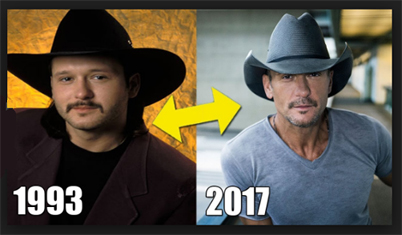
As a freshman at Northeast Louisiana State University,
McGraw took pre-law courses, but after buying a guitar at a pawn shop and singing
in clubs around Monroe, Louisiana, he soon decided to quit school and try his
luck in Nashville. His first self-titled album came out in April of 1993, but
sank into oblivion. To drum up attention, the label sent McGraw on the road
with his band, the Dance Hall Doctors, and his live act went over big. With
power ballads and party hits like Steve Miller's "The Joker," he
found his audience.
In
February 1994, McGraw released the infectious single "Indian Outlaw,"
and it quickly raced up the country charts and became a radio hit. However, it
also earned him unwanted status as a novelty act, and attracted a bitter
backlash from many who found it offensive to Native Americans. McGraw responded by stating that he had meant
no harm, and that he had simply used the tribal names and other words for their
rhyming qualities.
Shortly
after this brouhaha, McGraw's second album was released. Not a Moment
Too Soon became the number one country hit in its first week on the
charts. Also, three more singles off the effort topped the charts in addition
to "Indian Outlaw." The album and the number one single "Don't
Take the Girl," a melodramatic ballad, racked up awards from the likes of
the Academy of Country Music and Country Music Television. McGraw was also
named best new country artist by Billboard and others.
The following year, in September 1995, McGraw released All
I Want which turned out to be another million seller. 1996 saw the
successful Spontaneous Combustion tour, which featured country singer Faith
Hill as the opening act. By the end of the tour, McGraw's personal life was
sizzling as well, and he asked Hill, who has a long list of country music
awards herself, to marry him. Hill later accepted
McGraw's proposal by writing "yes" on a mirror in his trailer while
he was on stage, and the couple married on October 6, 1996. Their first
daughter, Gracie, was born in 1997, second daughter, Maggie, was born the
following year, and youngest daughter Audrey was born in 2001.
In
June of 1997, McGraw produced another winner with Everywhere, which
rose to the top of the charts and included three number-one singles, among them
"It's Your Love," which he sang with Hill. Other highly successful
albums followed, and, adding to his already big cache of honors, in
2000, McGraw won his first Grammy Award for Best Country Collaboration with
Vocals for "Let's Make Love," a duet he sang with his wife.
The
accolades and hits kept coming for this country music superstar. Both Live
Like You Were Dying (2004) and Let It
Go (2007) hit the top of the country and pop album charts. "Live Like You Were Dying" netted McGraw his second Grammy
Award in 2004 for Best Male Country Vocal Performance. The following year, he
and his wife received their second shared Grammy for Best Country Collaboration
with Vocals for "Like We Never Loved Before."
In recent years, McGraw has remained one of country
music's most popular and enduring stars. He released Southern Voices in
2009, Emotional Traffic in 2012 and Sundown Heaven Town in
2014, which included the chart-topping country single "Shotgun Rider”.
While
embarking on their joint Soul2Soul World Tour in 2017, McGraw and Hill put the
finishing touches on a collaborative album, The Rest of Our Life. They
continued touring into 2018, but the exhaustive schedule seemingly caught up to
McGraw, who collapsed onstage while performing in Dublin, Ireland, in
mid-March. Hill later came out to say her husband was "super
dehydrated" and would not return.
In
late winter 2018, following the tragic shooting at Marjory Stoneman
Douglas High School in Florida, McGraw became one of the few mainstream country
stars to express his support of stronger gun-control measures. After the
sporting-goods store Dick's announced it would raise the minimum age for
purchasing guns or ammunition from 18 to 21 years, he tweeted, "Thank you
@Dicks for taking a stand to promote a meaningful discussion for the safety of
our kids!"