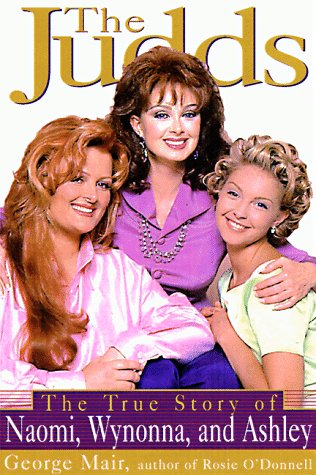
The Judds biography
Up until the rise of Brooks & Dunn in the '90s, the Judds were the
most commercially successful duo in country music history. Mother Naomi and
daughter Wynonna enjoyed an astounding run of 14 number one singles from 1984
to 1989, ranking them as one of the most popular country acts of the '80s.
Their music combined elements of traditional country harmony singing,
bluegrass, and Appalachian folk with pop, rock, and polished contemporary
production. Moreover, Wynonna's powerful, bluesy, often sexy lead vocals
established her as one of the finest female country singers of her era.
But even more important than their widely accessible sound -- or their
considerable visual appeal -- was their sympathetic understanding of
working-class and small-town women, earned through a long, hard struggle of
their own.
The Judds' story began in Ashland, KY, where Naomi was born Diana Ellen
Judd on January 11, 1946. An honor roll student, she
often played piano in the Baptist church her family attended but shocked the
town by getting pregnant at age 17 by a man who abandoned her immediately.
Hoping to save face, she married new sweetheart Michael Ciminella
giving birth to Wynonna (born Christina Ciminella,
May 30, 1964).
In 1968, the family moved to Los Angeles, and new daughter Ashley
(later, of course, a successful movie star) was born not long after.
In 1976, she moved the family back to Kentucky, where they lived in a
mountain home with no phone or TV. Music helped pass the time, and Wynonna
began playing the guitar and harmonizing with her mother, who was in the
meantime studying to become a nurse. She renamed herself Naomi and brought
the family back to the West Coast to finish her nursing degree. Wynonna's
singing talent was by then readily apparent, and in 1979, the Judds moved to
Nashville in hopes of making it in the music business.
Naomi and Wynonna made tapes
of themselves on a cheap cassette recorder and sometimes sang on Ralph Emery's
local morning show. They caught their first big break through Naomi's nursing
job: one of her patients happened to be the daughter of record producer Brent
Maher, and that contact eventually led to an audition for RCA executives in
early 1983. the Judds were signed on the spot and issued their debut single, "Had
a Dream (For the Heart)," late in the year. It reached the country Top 20,
and it was accompanied by a quickly assembled mini-album, The Judds. Their
second single, "Mama He's Crazy," was a breakout hit that went all
the way to number one and later won a Grammy for Best Country Vocal by a Duo or
Group. Their first true full-length, Why Not Me, was released in 1984 and took
its place as a classic of modern country, establishing the Judds as spokeswomen
for a new generation of female country music fans. The Grammy-winning title
track, "Girls Night Out," and "Love Is Alive" all went on
to top the country charts, as did the album, which also sold over a million
copies.
The Judds were now full-fledged stars, and they spent the rest of the
'80s cranking out hit after hit. 1985's exuberant Rockin'
With the Rhythm spawned four number one singles in "Have Mercy,"
"Grandpa (Tell Me 'Bout the Good Old Days", another Grammy winner),
"Rockin' With the Rhythm in the Rain," and
"Cry Myself to Sleep." 1987's Heartland was widely viewed as more
uneven than its predecessors but kept their hit streak going strong with the
chart-toppers "I Know Where I'm Going," "Maybe Your Baby's Got
the Blues," and "Turn It Loose." The ten-track Greatest
Hits was released in 1988 and featured two new songs: "Give a Little
Love," which went to number two and won another Grammy, and "Change
of Heart," which hit number one. 1989's River of Time became the first
Judds album not to top the country charts since their debut mini-album but
continued their streak of consecutive million-sellers all the same. "Young
Love (Strong Love)" and "Let Me Tell You About Love" both hit
number one and would prove to be the last Judds songs to do so.
By this point in the Judds'
career, mother and daughter were clearly distinct personalities. Naomi was the
extroverted stage presence, the sometime songwriter, the ambitious
businesswoman who steered the group's career and pushed her daughter to keep
realizing her talent. Wynonna -- despite her quiet, reserved demeanor -- was a prodigiously talented vocal stylist who
grew surer of herself with every passing release and rebelled more and more
forcefully against her mother's direction. By the time Love Can Build a Bridge
was released in 1990, there was already speculation that Wynonna was ready to
mount a solo career.
Not long after the album was released, Naomi announced that she had been
diagnosed with hepatitis C, a chronic and life-threatening illness that she had
likely contracted from a needle during her days as a nurse. The constant touring had already begun to take its toll on her health,
and she elected to retire from performing and recording, following one last
farewell tour in 1991. Love Can Build a Bridge produced several hits, including
the Top Fivers "Born to Be Blue" and the title track, and the tour
was unsurprisingly a blockbuster success.
Wynonna released her solo
debut in 1992 and followed it with several more successful albums over the
course of the '90s. Naomi, meanwhile, sought alternative medical treatment for
the disease that was expected to take her life in several years. She published
her autobiography, Love Can Build a Bridge, in 1993; the book was later turned
into a TV-movie. By 1999, Naomi's hepatitis had somehow gone into remission,
and she and Wynonna reunited for a gala New Year's Eve concert to ring in the
new millennium; it was later released as The Judds Reunion Live. A full-fledged
reunion tour followed in 2000, and four newly recorded Judds songs were issued
exclusively on a bonus disc included with Wynonna's solo album New Day Dawning. Following the
tour, Wynonna resumed her solo career, while Naomi made her primary living as a
motivational speaker.