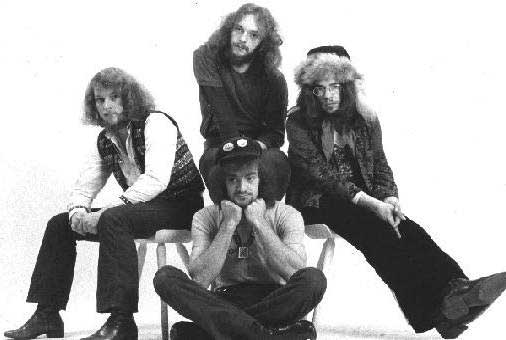
Jethro Tull biography
Jethro Tull was a unique phenomenon in popular music history.
Their mix of hard rock; folk melodies; blues licks; surreal, impossibly dense lyrics; and overall profundity defied easy analysis, but that didn't
dissuade fans from giving them
11 gold and five platinum albums. At the same time, critics rarely took them
seriously, and they were off the cutting
edge of popular music since the
end of the 1970s. But no record store in the
country would want to be without multiple copies of each of their most popular
albums (Benefit, Aqualung, Thick as a Brick, Living in the Past), or their various
best-of compilations, and few would knowingly ignore their newest releases. Of
their contemporaries, only Yes could claim a similar degree of success, and Yes
endured several major shifts in sound and membership in reaching the 1990s,
while Tull remained remarkably stable over the same
period. As co-founded and led by wildman-flautist-guitarist-singer-songwriter
Ian Anderson, the group carved a place all its own in popular music.
Tull had its roots in the British blues boom of the
late '60s. Anderson (b. Aug. 10, 1947, Edinburgh, Scotland)
had moved to Blackpool when he was 12. His
first band was called the Blades, named after James Bond's club, with Michael
Stephens on guitar, Jeffrey Hammond-Hammond (b. July 30,
1946) on bass and John Evans (b. Mar. 28, 1948) on drums, playing a mix of
jazzy blues and soulful dance music on the northern club circuit. In
1965, they changed their name to the John Evan Band (Evan having dropped the
"s" in his name at Hammond's
suggestion) and later the John Evan Smash. By the end of 1967, Glenn Cornick (b. Apr. 24, 1947, Barrow-in-Furness,
Cumbria, England) had
replaced Hammond-Hammond on bass. The group moved to Luton in order to be
closer to London, the center of the British blues
boom, and the band began to fall apart, when Anderson and Cornick
met guitarist/singer Mick Abrahams (b. Apr. 7, 1943, Luton, Bedfordshire,
England) and drummer Clive Bunker (b. Dec. 12, 1946), who had previously played
together in the Toggery Five and were now members of
a local blues band called McGregor's Engine.
In December of 1967, the four of them agreed to form a new group. They
began playing two shows a week, trying out different names, including Navy Blue
and Bag of Blues. One of the names that they used, Jethro
Tull, borrowed from an 18th-century farmer/inventor,
proved popular and memorable, and it stuck. In January of 1968, they cut a
rather derivative pop-folk single called "Sunshine Day," released by
MGM Records (under the misprinted name Jethro Toe)
the following month. The single went nowhere, but the group managed to land a
residency at the Marquee Club in London,
where they became very popular.
Early on, they had to face a problem of image and configuration,
however. In the late spring of 1968, managers Terry Ellis and Chris Wright (who
later founded Chrysalis Records) first broached the idea that Anderson give up
playing the flute, and to allow Mick Abrahams to take center
stage. At the time, a lot of blues enthusiasts didn't accept wind instruments
at all, especially the flute, as seminal to the sound they were looking for,
and as a group struggling for success and recognition, Jethro
Tull was just a little too strange in that regard. Abrahams
was a hardcore blues enthusiast who idolized British blues godfather Alexis Korner, and he was pushing for a more traditional band
configuration, which would've put him and his guitar out front. As it turned
out, they were both right. Abrahams' blues sensibilities were impeccable, but
the audience for British blues by itself couldn't elevate Jethro
Tull any higher than being a top club act. Anderson's antics
on-stage, jumping around in a ragged overcoat and standing on one leg while
playing the flute, and his use of folk sources as well as blues and jazz, gave
the band the potential to grab a bigger audience and some much-needed press
attention.
They opened for Pink Floyd on June 29, 1968, at the first free rock
festival in London's Hyde
Park, and in August they were the hit of the Sunbury Jazz &
Blues Festival in Sunbury-on-Thames. By the end of the summer, they had a
recording contract with Island Records. The resulting album, This Was, was
issued in November. By this time, Anderson
was the dominant member of the group on-stage, and at the end of the month
Abrahams exited the band. The group went through two hastily recruited and
rejected replacements, future Black Sabbath guitarist Tony Iommi
(who was in Tull for a week, just long enough to show
up in their appearance on the Rolling Stones' Rock 'N Roll Circus
extravaganza), and Davy O'List, the former guitarist
with the Nice. Finally, Martin Barre (b. Nov. 17,
1946), a former architecture student, was the choice for a permanent
replacement.
It wasn't until April of 1969 that This Was got a U.S. release. Ironically,
the first small wave of American Jethro Tull fans were admiring a group whose sound had already
changed radically; in May of 1969, Barre's first
recording with the group, "Living in the Past," reached the British
number three spot and the group made its debut on Top of the Pops performing
the song. The group played a number of festivals that summer, including the
Newport Jazz Festival. Their next album, Stand Up, with all of its material
(except "Bouree," which was composed by
Johann Sebastian Bach) written by Ian Anderson, reached the number one spot in
England the next month. Stand Up also contained the first orchestrated track by
Tull, "Reasons for Waiting," which featured
strings arranged by David Palmer, a Royal Academy of Music graduate and
theatrical conductor who had arranged horns on one track from This Was. Palmer
would play an increasingly large role in subsequent albums, and finally join
the group officially in 1977.
Meanwhile, "Sweet Dream," issued in November, rose to number
seven in England,
and was the group's first release on Wright and Ellis' newly formed Chrysalis
label. Their next single, "The Witch's Promise," got to number four
in England
in January of 1970. The group's next album, Benefit, marked their last look
back at the blues, and also the presence of Anderson's longtime
friend and former bandmate John Evan -- who had long
since given up the drums in favor of keyboards -- on
piano and organ. Benefit reached the number three spot in England, but, much
more important, it ascended to number 11 in America, and its songs, including
"Teacher" and "Sossity, You're A
Woman," formed a key part of Tull's stage
repertory. In early July of 1970, the group shared a bill with Jimi Hendrix, B.B. King, and Johnny Winter at the Atlanta
Pop Festival in Byron, GA, before 200,000 people.
By the following December, after another U.S.
tour, Cornick had decided to leave the group, and was
replaced on bass by Anderson's
childhood friend Jeffrey Hammond-Hammond. Early the following year, they began
working on what would prove to be, for many fans, the group's magnum opus,
Aqualung. Anderson's
writing had been moving in a more serious direction since the group's second
album, but it was with Aqualung that he found the lyrical voice he'd been
seeking. Suddenly, he was singing about the relationship between man and God,
and the manner in which -- in his view -- organized religion separated them. The
blues influences were muted almost to non-existence, but the hard rock passages
were searing and the folk influences provided a refreshing contrast. That the
album was a unified whole impressed the more serious critics, while the kids
were content to play air guitar to Martin Barre's
high-speed breaks. And everybody, college prog rock
mavens and high-school time-servers alike, seemed to identify with the theme of
alienation that lay behind the music.
Aqualung reached number seven in America
and number four in England,
and was accompanied by a hugely successful American tour. Bunker quit the band
to get married, and was replaced by Anderson's
old John Evan Smash bandmate Barriemore
Barlow (b. Sept. 10, 1949). Late in 1971, they began work on their next album,
Thick as a Brick. Structurally more ambitious than Aqualung, and supported by
an elaborately designed jacket in the form of a newspaper, this record was
essentially one long song steeped in surreal imagery, social commentary, and
Anderson's newly solidified image as a wildman-sage. Released
in England during April of 1972, Thick as a Brick got as high as the number
five spot, but when it came out in America a month later, it hit the number one
spot, making it the first Jethro Tull
album to achieve greater popularity in American than in England. In June of
1972, in response to steadily rising demand for the group's work, Chrysalis
Records released Living in the Past, a collection of tracks from their various
singles and British EPs, early albums, and a Carnegie Hall show, packaged like
an old-style 78 rpm album in a book that opened up.
At this point, it seemed as though Jethro Tull could do no wrong, and for the fans that was true. For
the critics, however, the group's string ran out in July of 1973 with the
release of A Passion Play. The piece was another extended song, running the
length of the album, this time steeped in fantasy and religious imagery far
denser than Aqualung; it was divided at the end of one side of the album and
the beginning of the other by an A.A. Milne-style story called "The Hare
That Lost His Spectacles." This time, the critics were hostile toward
Anderson and the group, attacking the album for its obscure lyrical references
and excessive length. Despite these criticisms, the album reached number one in
America (yielding a number
eight single edited from the extended piece) and number 13 in England. The
real venom, however, didn't start to flow until the group went on tour that
summer. By this time, their sets ran to two-and-a-half hours, and included not
only the new album done in its entirety ("The Hare That Lost His
Spectacles" being a film presentation in the middle of the show), but
Thick As a Brick and the most popular of the group's songs off of Aqualung and
their earlier albums. Anderson
was apparently unprepared for the searing reviews that started appearing, and
also took the American rock press too seriously. In the midst of a sell-out U.S. tour, he threatened to cancel all upcoming
concerts and return to England.
Fortunately, cooler heads prevailed, especially once he recognized that the
shows were completely sold out and audiences were ecstatic, and the tour continued
without interruption.
It was 16 months until the group's next album, War Child -- conceived as
part of a film project that never materialized -- was released, in November of
1974. The expectations surrounding the album gave it pre-order sales sufficient
to get it certified gold upon release, and it was also Tull's
last platinum album, reaching number two in America
and number 14 in England.
The dominant theme of War Child seemed to be violence, though the music's
trappings heavily featured Palmer's orchestrations, rivaling
Barre's electric guitar breaks for attention. In any
case, the public seemed to respond well to the group's return to conventional
length songs, with "Bungle in the Jungle" reaching number 11 in America. Tull's successful concert tour behind this album had them
augmented by a string quartet.
During this period, Anderson
became involved with producing an album by Steeleye
Span, a folk-rock group that was also signed to Chrysalis, and who had opened
for Tull on one of their American tours. Their music
slowly begun influencing Anderson's
songwriting over the next several years, as the folk
influence grew in prominence, a process that was redoubled when he took up a
rural residence during the mid-'70s. The next Tull
album, Minstrel in the Gallery, showed up ten months later, in September of
1975, reaching number seven in the United States. This time, the
dominant theme was Elizabethan minstrelsy, within an electric rock and English
folk context. The tracks included a 17-minute suite that recalled the group's
earlier album-length epic songs, but the album's success was rather more
limited.
The Jethro Tull lineup had been remarkably stable ever since Clive Bunker's
exit after Aqualung, remaining constant across four albums in as many years. In
January of 1976, however, Hammond-Hammond left the band to pursue a career in
art. His replacement, John Glascock (b. 1953), joined
in time for the recording of Too Old to Rock 'n Roll, Too Young to Die, an
album made up partly of songs from an un-produced play proposed by Anderson and
Palmer, released in May of 1976. The group later did an ITV special built
around the album's songs. The title track, however (on which Steeleye Span's Maddy Prior
appeared as a guest backing vocalist), became a subject of controversy in England, as critics took it to be a personal
statement on Anderson's
part.
In late 1976, a Christmas EP entitled Ring Out Solstice Bells got to
number 28. This song later turned up on their next album, Songs From the Wood,
the group's most artistically unified and successful album in some time (and
the first not derived from an unfinished film or play since A Passion Play). This
was Tull's folk album, reflecting Anderson's passion for English folk songs. Its
release also accompanied the band's first British tour in nearly three years. In
May of 1977, David Palmer joined Tull as an official
member, playing keyboards on-stage to augment the richness of the group's
concert sound.
Having lasted into the late '70s, Jethro Tull now found itself competing in a new musical
environment, as journalists and, to an increasing degree,
fans became fixated on the growing punk rock phenomenon. In October 1977,
Repeat (The Best of Jethro Tull,
Vol. 2), intended to fill an anticipated 11 month gap between Tull albums, was released on both
sides of the Atlantic. Unfortunately, it
contained only a single new track and never made the British charts, while
barely scraping into the American Top 100 albums. The group's next new album,
Heavy Horses, issued in April of 1978, was Anderson's most personal work in
several years, the title track expressing his regret over the disappearance of
England's huge shire horses as casualties of modernization. In the fall of
1978, the group's first full-length concert album, the double-LP Live-Bursting
Out, was released to modest success, accompanied by a tour of the United States
and an international television broadcast from Madison Square Garden.
1979 was a pivotal and tragic year for the group. John Glascock died from complications of heart surgery on
November 17, five weeks after the release of Stormwatch.
Tull was lucky enough to acquire the services of Dave
Pegg, the longtime bassist
for Fairport Convention, which had announced its formal (though, as it turned
out, temporary) breakup. The Stormwatch
tour with the new lineup was a success, although the
album was the first original release by Jethro Tull since This Was not to reach the U.S. Top 20. Partly
thanks to Pegg's involvement with the Tull lineup, future tours by Jethro Tull, especially in America, would
provide a basis for performances by re-formed incarnations of Fairport
Convention.
The lineup change caused by Glascock's death led to Anderson's decision to record a
solo album during the summer of 1980, backed by Barre,
Pegg, and Mark Craney on
drums, with ex-Roxy Music/King Crimson
multi-instrumentalist Eddie Jobson on violin. The record, A, was eventually
released as a Jethro Tull
album in September of 1980, but even the Tull name
didn't do much for its success. Barlow, Evan, and Palmer, however, were dropped
from the group's lineup with the recording of A, and
the new version of Jethro Tull
toured in support of the album. Jobson left once the tour was over, and it was
with yet another new lineup -- including Barre, Pegg, and Fairport
Convention alumnus Gerry Conway (drums) and Peter-John Vettesse
(keyboards) -- that The Broadsword and the Beast was recorded in 1982. Although
this album had many songs based on folk melodies, its harder rocking passages
also had a heavier, more thumping beat than earlier versions of the band had
produced, and the use of the synthesizer was more pronounced than on previous Tull albums.
In 1983, Anderson
confined his activities to his first official solo album, Walk Into Light,
which had a very different, synthesizer-dominated sound. Following its lackluster performance, Anderson revived Jethro
Tull for the album Under Wraps, released in September
of 1984. At number 76 in the U.S.,
it became the group's poorest selling album, partly a
consequence of Anderson's
developing a throat infection that forced the postponement of much of their
planned tour. No further Tull albums were to be
released until Crest of a Knave in 1987, as a result of Anderson's intermittent throat problems. In
the meantime, the group appeared on a German television special in March of
1985, and participated in a presentation of the group's work by the London
Symphony Orchestra. To make up for the shortfall of new releases, Chrysalis
released another compilation, Original Masters, a collection of highlights of
the group's work, in October of 1985. In 1986, A Classic Case: The London
Symphony Orchestra Plays the Music of Jethro Tull was released on record; and Crest of a Knave performed
surprisingly well when it was issued in September of 1987, reaching number 19
in England and number 32 in America with the support of a world tour.
Crest of a Knave was something of a watershed in Tull's later history,
though nobody would have guessed
it at the time of its release. Although
some of its songs displayed the group's usual
folk/hard rock mix, the group was playing
louder than usual, and tracks like "Steel Monkey," had a harder sound
than any previous record by the group.
In
1988, Tull toured the United States as part of the
celebration of the band's 20th anniversary. In July, Chrysalis issued 20 Years
of Jethro Tull, a 65-song
boxed-set collection covering the group's history up to that time, containing
most of their major songs and augmented with outtakes and radio performances. In
February of 1989, the band won the Grammy Award for Best Hard Rock/Metal
Performance for Crest of a Knave. Suddenly, they were stars again, and being
declared as relevant by one of the top music awards in the industry; a fact
that kept critics buzzing for months over whether the group deserved it before
finally attacking the voting for the Grammy Awards and the membership of its
parent organization, the National Association of Recording Arts and Sciences.
Rock Island, another hard rocking album, reached a very healthy number
18 in England during September of the same year, while peaking only at 56 in
America, despite a six-week U.S. tour to support the album. In 1990, the album
Catfish Rising did less well, reaching only 27 in England
and 88 in America
after its release in September. And A Little Light Music, their own
"unplugged" release, taped on their summer 1992 European tour, only
got to number 34 in England
and 150 in the United States.
Despite declining numbers, the group
continued performing to good-sized houses when they toured,
and the group's catalog performed extremely well.