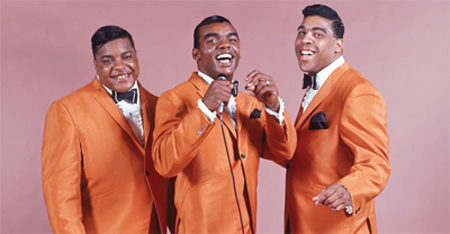
The Isley brothers biography
First
formed in the early '50s, the Isley Brothers enjoyed
one of the longest, most influential, and most diverse careers in the pantheon
of popular music -- over the course of nearly a half century of performing, the
group's distinguished history spanned not only two generations of Isley siblings but also massive cultural shifts which
heralded their music's transformation from gritty R&B to Motown soul to blistering funk. The first generation of Isley siblings was born and raised in Cincinnati, OH, where
they were encouraged to begin a singing career by their father, himself a
professional vocalist, and their mother, a church pianist who provided musical
accompaniment at their early performances. Initially a gospel quartet, the
group was comprised of Ronald, Rudolph, O'Kelly, and Vernon Isley;
after Vernon's 1955 death in a bicycling accident, tenor Ronald was tapped as
the remaining trio's lead vocalist. In 1957, the brothers went to New York City
to record a string of failed doo wop singles; while performing a spirited
reading of the song "Lonely Teardrops" in Washington, D.C., two years
later, they interjected the line "You know you make me want to
shout," which inspired frenzied audience feedback. An RCA executive in the
audience saw the concert, and when he signed the Isleys
soon after, he instructed that their first single be constructed around their
crowd-pleasing catch phrase; while the call-and-response classic
"Shout" failed to reach the pop Top 40 on its initial release, it
eventually became a frequently covered classic.
Still,
success eluded the Isleys, and only after they left
RCA in 1962 did they again have another hit, this time with their seminal cover
of the Top Notes' "Twist and Shout." Like so many of the brothers'
early R&B records, "Twist and Shout" earned greater commercial
success when later rendered by a white group -- in this case, the Beatles;
other acts who notched hits by closely following the Isleys'
blueprint were the Yardbirds
("Respectable," also covered by the Outsiders), the Human Beinz ("Nobody but Me"), and Lulu
("Shout"). During a 1964 tour, they recruited a young guitarist named
Jimmy James to play in their backing band; James -- who later shot to fame
under his given name, Jimi Hendrix -- made his first
recordings with the Isleys, including the single
"Testify," issued on the brothers' own T-Neck label. They signed to
the Motown subsidiary Tamla
in 1965, where they joined forces with the famed Holland-Dozier-Holland writing
and production team. Their first single, the shimmering "This Old Heart of
Mine (Is Weak for You)," was their finest moment yet, and barely missed
the pop Top Ten.
"This
Old Heart of Mine" was their only hit on Motown,
however, and when the song hit number three in Britain in 1967, the Isleys relocated to England in order to sustain their
flagging career; after years of writing their own material, they felt
straitjacketed by the Motown assembly-line production
formula, and by the time they returned stateside in 1969, they had exited Tamla to resuscitate the T-Bone label. Their next release,
the muscular and funky "It's Your Thing," hit number two on the U.S.
charts in 1969, and became their most successful record. That year, the Isleys also welcomed a number of new members as younger
brothers Ernie and Marvin, brother-in-law Chris Jasper, and family friend
Everett Collins became the trio's new backing unit. Spearheaded by Ernie's
hard-edged guitar leads, the group began incorporating more and more rock
material into its repertoire as the 1970s dawned, and scored hits with covers
of Stephen Stills' "Love the One You're With,"
Eric Burdon & War's "Spill the Wine," and Bob Dylan's "Lay
Lady Lay."
In 1973, the Isleys scored a massive hit with
their rock-funk fusion cover of their own earlier single "Who's That Lady,"
retitled "That Lady, Pt. 1"; the album 3 +
3 also proved highly successful, as did 1975's The Heat Is On, which spawned
the smash "Fight the Power, Pt. 1." As the decade wore on, the group
again altered its sound to fit into the booming disco market; while their
success on pop radio ran dry, they frequently topped the R&B charts with
singles like 1977's "The Pride," 1978's "Take Me to the Next
Phase, Pt. 1," 1979's "I Wanna Be With You,
Pt. 1," and 1980's "Don't Say Goodnight." While the Isleys' popularity continued into the 1980s, Ernie and
Marvin, along with Chris Jasper, defected in 1984 to form their own group, Isley/Jasper/Isley; a year later, they topped the R&B
charts with "Caravan of Love." On March 31, 1986, O'Kelly died of a
heart attack; Rudolph soon left to join the ministry, but the group reunited in
1990. Although the individual members continued with solo work and side
projects, the Isley Brothers forged on in one form or
another throughout the decade; in 1996, now consisting of Ronald, Marvin, and
Ernie, they released the album Mission to Please. Ronald and Ernie hooked up
several years later for Eternal (2001), a brand-new selection of R&B cuts
featuring collaborative efforts with Jill Scott, Jimmy Jam and Terry Lewis, and
Raphael Saadiq. On that particular release, Ronald
also introduced the alter ego Mr. Biggs. Body Kiss
(2003) and Baby Makin' Music (2006) followed. ~