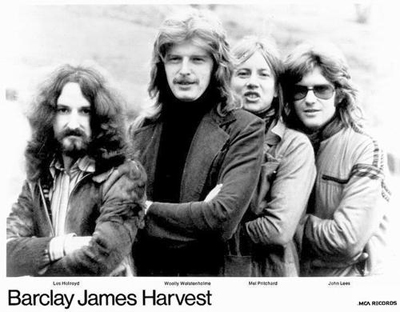
Barcley James Harvest biography
Barclay James Harvest was,
for many years, one of the most hard luck outfits in progressive rock. A
quartet of solid rock musicians - John Lees, guitar, vocals; Les Holroyd, bass,
vocals; Stuart "Wooly" Wolstenholme, keyboards,
vocals; and Mel Pritchard, drums - with a knack for writing hook-laden songs
built on pretty melodies, they harmonized like the Beatles and wrote extended
songs with more of a beat than the Moody Blues. They were signed to EMI at the
same time as Pink Floyd, and both bands moved over to the company's progressive
rock-oriented Harvest imprint at the same time, yet somehow, they never managed
to connect with the public for a major hit in England, much less America.
The group was formed in
September of 1966 in Oldham, Lancashire. Lees and Wolstenholme were classmates
who played together in a band called the Blues Keepers; that group soon merged
with a band called the Wickeds, which included
Holroyd and Pritchard. They became Barclay James Harvest in June of 1967 and
cut a series of demos late in the year, and by the spring of 1968 they were
signed to EMI's Parlophone
label; in April they issued their first single, a folky,
faux-classical song called "Early Morning."
In 1970, they released their
first album, Barclay James Harvest, which included several of the early songs
and displayed the group's strengths: filled with strong harmony singing,
aggressive electric guitar, and swelling Mellotron
parts, it set the pattern for their subsequent releases, with Lees and Holroyd
handling most of the songwriting. The album failed to
chart, and a subsequent tour was a financial disaster.
Their second album, Once
Again (1971), was an artistic letdown, made up of rather lethargic songs,
although it did contain the superb, "Mockingbird."
Later in 1973, the band
signed with Polydor, and their fortunes began turning
around, though only very gradually. Their first album for the new label,
Everyone Is Everybody Else, seemed promising: it was a more powerful and
coherent work than the group had ever released for EMI, with Lees' guitar
dominating on songs like "Paper Wings" and "For No One."
It seemed at first as though
BJH was locked once again into a cycle of failure. Finally, in late 1974, their
double-album Barclay James Harvest Live broke through to the public -- the
group was rewarded with a Top 40 placement in England and more sales activity
on the European continent than they'd previously seen.

In 1977, they released Gone
to Earth, their most accomplished album to date, and by the end of the year the
group found themselves playing to arena-sized audiences. The release of XII in
1978 -- which managed to just miss the British Top 30 -- was followed by the
group's first (and only) personnel shake-up. In June of 1979, Wolstenholme
announced his exit from the band in favor of a solo
career, he was replaced by two new members, singer-keyboardman-saxophonist
Kevin McAlea and singer-guitarist-keyboardman
Colin Browne.
Their 1979 album Eyes of the
Universe was a modest hit in England, but its release marked a flashpoint in
Barclay James Harvest's career in continental Europe, especially Germany; on
August 30, 1980, the band performed a free concert in front of nearly 200,000
people at the Reichstag in Berlin, which was filmed and recorded. A subsequent
live album, Concert for the People, became the group's biggest-selling album in
England, rising to number 15 in 1982.
The group marked their 25th
anniversary with a concert in Liverpool, and toured to support a British Polydor compilation, The Best of Barclay James Harvest.