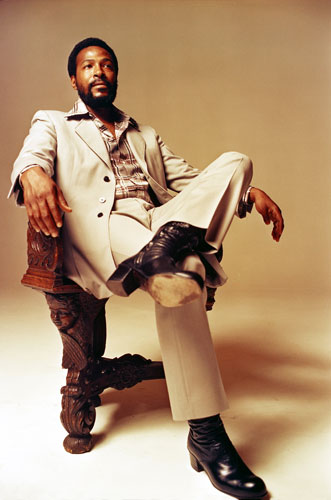
Marvin Gaye biography
One of the most gifted,
visionary, and enduring talents ever launched into orbit by the Motown hit machine, Marvin Gaye blazed the trail for the
continued evolution of popular black music. Moving from lean, powerful R&B
to stylish, sophisticated soul to finally arrive at an intensely political and
personal form of artistic self-expression, his work not only redefined soul
music as a creative force but also expanded its impact as an agent for social
change.
Marvin Pentz Gay, Jr. was born April 2, 1939, in Washington, D.C.
The second of three children born to the Reverend Marvin Gay, Sr., an ordained
minister in the House of God - a conservative Christian sect that fuses
elements of orthodox Judaism and Pentecostalism,
imposes strict codes of conduct, and observes no holidays - he began singing in
church at the age of three, quickly becoming a soloist in the choir. Gaye later
took up piano and drums, and music became his escape from the nightmarish
realities of his home life -- throughout his childhood, his father beat him on
an almost daily basis.
After graduating from
high school, Gaye enlisted in the U.S. Air Force; upon his discharge, he
returned to Washington and began singing in a number of street-corner doo wop
groups, eventually joining the Rainbows, a top local attraction.
While first working at Motown as a session drummer and playing on early hits by Smokey
Robinson & the Miracles, he met Gordy's sister Anna, and married her in
late 1961. Upon mounting a solo career, Gaye struggled to find his voice; with
1963's "Pride and Joy," Gaye scored his first Top Ten smash.
With 1964's Together, a
collection of duets with Mary Wells, Gaye scored his first charting album; the
duo also notched a number of hit singles together, including "Once Upon a
Time" and "What's the Matter With You,
Baby?" As a solo performer, Gaye continued to enjoy great success, scoring
three superb Top Ten hits - "Ain't That
Peculiar," "I'll Be Doggone," and "How Sweet It Is (To Be
Loved by You)" - in 1965. In total, he scored some 39 Top 40 singles for Motown, many of which he also wrote and arranged.
However, Gaye's greatest
duets were with Tammi Terrell, with whom he scored a series of massive hits
penned by the team of Nickolas Ashford and Valerie Simpson, including 1967's
"Ain't No Mountain High Enough" and
"Your Precious Love," followed by 1968's "Ain't
Nothing Like the Real Thing" and "You're All I Need to Get By."
At the same time, Gaye
was forced to cope with a number of other personal problems, not the least of
which was his crumbling marriage. He also found the material he recorded for Motown to be increasingly irrelevant in the face of the
tremendous social changes sweeping the nation, and after scoring a pair of 1969
Top Ten hits with "Too Busy Thinking About My Baby" and "That's
the Way Love Is," he spent the majority of 1970 in seclusion, resurfacing
early the next year with the self-produced What's Going On, a landmark effort
heralding a dramatic shift in both content and style that forever altered the
face of black music.
The ambitions and
complexity of What's Going On baffled Berry Gordy, who initially refused to
release the LP; he finally relented, although he maintained that he never
understood the record's full scope. Gaye was vindicated when the majestic title
track reached the number two spot in 1971, and both of the follow-ups,
"Mercy Mercy Me (The Ecology)" and
"Inner City Blues (Make Me Wanna Holler),"
also reached the Top Ten. The album's success guaranteed Gaye continued
artistic control over his work and helped loosen the reins for other Motown artists, most notably Stevie Wonder, to also take
command of their own destinies.
The long-simmering
eroticism implicit in much of Gaye's work reached its boiling point with 1973's
Let's Get It On, one of the most sexually charged albums ever recorded; a work
of intense lust and longing, it became the most commercially successful effort
of his career, and the title cut became his second number one hit. Let's Get It
On also marked another significant shift in Gaye's lyrical outlook, moving him
from the political arena to a deeply personal, even insular stance that
continued to define his subsequent work.
As a result of a 1976
court settlement, Gaye was ordered to make good on missed alimony payments by
recording a new album, with the intention that all royalties earned from its
sales would then be awarded to his ex-wife. The 1978 record, a two-LP set
sardonically titled Here, My Dear, bitterly explored the couple's relationship
in such intimate detail that Anna Gordy briefly considered suing Gaye for
invasion of privacy.
As his drug problems
increased and his marriage to new wife Janis also began to fail, he relocated
to Hawaii in an attempt to sort out his personal affairs.
In 1981, longstanding tax
difficulties and renewed pressures from the IRS forced Gaye to flee to Europe,
where he began work on the ambitious In Our Lifetime, a deeply philosophical
record that ultimately severed his longstanding relationship with Motown after he claimed the label had remixed and edited
the album without his consent. Additionally, Gaye stated that the finished
artwork parodied his original intent, and that even the title had been changed
to drop an all-important question mark. Upon signing with Columbia in 1982, he
battled stories of erratic behavior and a consuming
addiction to cocaine to emerge triumphant with Midnight Love,
an assured comeback highlighted by the luminous Top Three hit "Sexual
Healing." The record made Gaye a star yet again.
Gaye's career resurgence
brought with it an increased reliance on cocaine; finally, his personal demons
forced him back to the U.S., where he moved in with his parents in an attempt
to regain control of his life. Tragically, the return home only exacerbated his
spiral into depression; he and his father quarrelled bitterly, and Gaye
threatened suicide on a number of occasions. Finally, on the afternoon of April
1, 1984 - one day before his 45th birthday - Gaye was shot and killed by Marvin
Sr. in the aftermath of a heated argument.