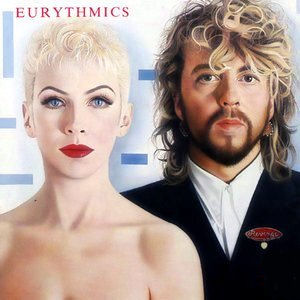
Eurythmics biography
Eurythmics were perhaps the greatest of the
early-'80s British synth-pop bands, mixing a
cynically business- and image-conscious approach with a sometimes soulful,
mournful sound. Although Dave Stewart's studio wizardry provided the band's
foundation, Annie Lennox's theatrical appearance and beautiful, icy wail
ultimately were the duo's calling cards.
Lennox grew up
in Aberdeen, Scotland, the only daughter of a bagpipe-playing shipyard worker. Her
piano- and flute-playing skills won her a scholarship
to the Royal Academy of Music in London, but she quit on the eve of finals,
disgusted with the school's pretensions. She spent three years working odd jobs
in London and playing with a folk-rock band, a jazz-rock group, and a cabaret
duo. A friend introduced her to Dave Stewart.Stewart
came from an upper-middle-class family in Northern England. By the early '70s
his band Longdancer was signed to Elton John's Rocket
Records but never accomplished anything. He then played in a variety of groups,
which ranged from soul to medieval music. When he met Lennox he was writing
music with a recluse named Peet Coombes.
Lennox and Stewart immediately began a musical and
romantic partnership. With Coombes they formed a band
called Catch, which shortly became the Tourists. The Tourists' three albums (The
Tourists, 1979; Reality Effect, 1979; Luminous Basement,
1980) mixed folk, psychedelia, and new wave. A cover
of the Dusty Springfield hit "I Only Want to Be With
You" was a big hit in England (Number Four U.K., 1979), but barely made it
into the U.S. Hot 100 (Number 83, 1980).
When the band
disintegrated in late 1980, so did Lennox and Stewart's romance. They continued
to work together, however, and named their partnership after Eurythmics, a system of music instruction developed in the
1890s that emphasizes physical response. Their debut was recorded in Germany
and featured Blondie drummer Clem Burke, members of Can and DAF, and Marcus
Stockhausen, son of the avant-garde composer. Despite good reviews, it was
weakly supported by their label.
Lennox and
Stewart were committed to making the Eurythmics a
solid business and artistic venture, however. In a makeshift studio that
Stewart set up, they recorded Sweet Dreams (Are Made of This)
(Number 15, 1983), using an 8-track recorder and synthesizers. Though the first
British single, "Love Is a Stranger," attracted some attention in
clubs, it was the title track (Number One) that propelled the band to stardom.
Touch (Number Seven, 1983) yielded
"Here Comes the Rain Again" (Number Four, 1984), but Eurythmics' next release, the soundtrack for 1984
(the film based on George Orwell's novel), was a disappointment. The film's
director complained on a televised awards show that he had been forced to use
the band's music, and the single "Sexcrime
(Nineteen Eighty-four)" was widely misinterpreted. Lennox suffered another
public humiliation when she married a Hare Krishna and divorced him a year
later.
In 1987 Stewart
married singer Siobhan Fahey, formerly of Bananarama
and later half of the duo Shakespear's Sister. Many
critics considered the Eurythmics to have run out of
steam on We Too Are One (Number 34, 1989), so it was not surprising when
Lennox announced that she was taking a couple years off from music to work for
a homeless charity. She had delivered a stillborn baby in 1988 and wanted to
devote time to her family (she is married to filmmaker Uri Fruchtmann,
with whom she's since had two children). In 1992 she released Diva
(Number 23, 1992), a platinum-selling solo album that received three Grammy
nominations.
Lennox and
Stewart hadn't spoken with each other for four years when she called in 1997 to
inform him of the death of their former Tourists bandmate,
Peet Coombes. The
conversation got the duo talking again; later, while rehearsing for an acoustic
performance at a party for a mutual friend, they began writing new material
together. Peace (1999), the album that grew out of those sessions, was
the first new Eurythmics LP in 10 years and found
Lennox's supple, powerful alto fully intact. It also eschewed the catchy,
electro-pop of the duo's '80s heyday in favor of
lushly orchestrated ballads focusing on the pair's musical and prior romantic
partnership. After the record's release, Stewart and Lennox played a series of
dates, most of them in Europe, the proceeds of which went to Amnesty
International and Greenpeace.