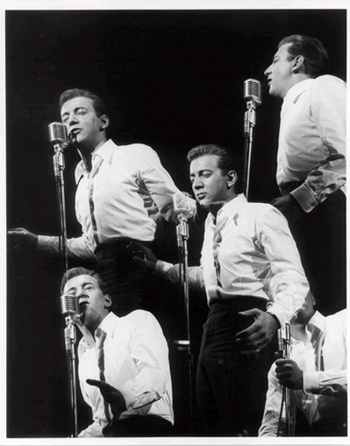
Bobby Darin biography
There's been considerable discussion about
whether Bobby Darin should be classified as a rock
& roll singer, a Vegas hipster cat, an interpreter of popular standards, or
even a folk-rocker. He was all of these and none of these. Throughout his
career he made a point of not becoming committed to any one style at the
exclusion of others; at the height of his nightclub fame he incorporated a folk
set into his act. When it appeared he could have gone on indefinitely as a sort
of junior version of Frank Sinatra, he would periodically record pop/rock and
folk-rock singles whose principal appeal lay outside of the adult pop market.
At one point he started calling himself Bob Darin and recorded songs with vague
anti-establishment overtones that could be said to be biting the largely
bourgeois hands that fed his highest-paying gigs. It may be most accurate to
say that Darin was, above all, a singer who
wanted to do a lot of things, rather than make his mark as a particular
stylist. That may have cost him some points as far as making it to the very top
of certain genres, but also makes his work more versatile than almost any other
vocalist of his era.
When Darin had his first hits
in the late '50s, he was a teen idol of sorts, albeit a teen idol with much
more talent and mature command than the typical singer in that style. The
novelty-tinged "Splish Splash" was his breakthrough smash, followed
by "Queen of the Hop" and the ballad "Dream Lover." There
was a slight R&B feel to Bobby's delivery that may well have influenced
R&B-pop/rock singers such as Dion, though it would be an exaggeration to
call Darin a blue-eyed soul man. In late 1959, he
found a new direction when the swinging "Mack the
Knife," a tune from Brecht-Weill's Threepenny Opera musical, made number
one. The song came from an album of pop standards, heralding his move toward
light big band jazz, which was consolidated by the Top Ten success of
"Beyond the Sea" in 1960.
In the early '60s, Darin had mostly abandoned rock for
the adult pop market, becoming a huge success on the Vegas-nightclub circuit,
and moving into the all-around entertainer mode with starring roles in movies
(including one as a non-singing jazz musician in John Cassavetes' Too Young
Blues). He also continued to score regular hits with the likes of "You
Must Have Been a Beautiful Baby," "Things," and "Lazy
River." To keep people guessing, there was also a hit cover of
"What'd I Say" and some country tunes (one of which, "You're the
Reason I'm Living," made it to number three on the pop charts). Around
1963, he put a folk section into his nightclub act that employed guitarist
Roger McGuinn, then a couple of years away from fame as the leader of the
Byrds.
Darin didn't make the expected retreat into Rat Pack
land when his records stopped making the upper reaches of the charts in the
mid-'60s. In 1965, there was a rather nice self-penned jangly folk-rocker,
"When I Get Home," that become a British hit
for the Searchers. Another 1965 flop, "We Didn't Ask to Be Brought
Here," was an unexpected antiwar tune. When he made his return to the Top
Ten in late 1966, it was with a cover of a gentle Tim Hardin folk-rock song,
"If I Were a Carpenter." His final Top 40 hit the following year,
"Lovin' You," opted for material by another major folk-rock composer,
John Sebastian.
Darin may indeed have been far hipper and more
politically aware than the average nightclub act, covering tunes by Dylan and
the Rolling Stones, participating in a 1965 civil rights march to Alabama, and
penning some Dylan-influenced songs of his own in the late '60s. It doesn't
seem accurate to say that this was the true Bobby Darin, shedding his show-biz
skin for something that came to him more naturally; in 1967, the same year he
covered Jagger-Richards' "Back Street Girl," he also recorded
material for an album entitled Bobby Darin Sings Doctor Dolittle. By the early
'70s he was working Vegas and similar joints again, exchanging his blue jeans
for a tuxedo, and hosting a TV variety series. In a much odder turn of events,
he was now recording for Motown, though these efforts met little success.
Afflicted with a rheumatic heart, Darin
was always aware that his time might be limited, and he died near the end of
1973 during open-heart surgery. He left behind a considerable quantity (and
diversity) of recorded work, and underwent a critical reevaluation of sorts,
especially among rock critics, which might have aided his election to the Rock
and Roll Hall of Fame in 1990. A 1996 four-CD box set, divided into thematic discs,
attempted to put his wide-ranging efforts into perspective. In 2004, actor
Kevin Spacey starred as Bobby Darin in the feature
film biography Beyond the Sea. Spacey also directed the film and sang Darin's songs for the film, which were released as the film's
soundtrack.