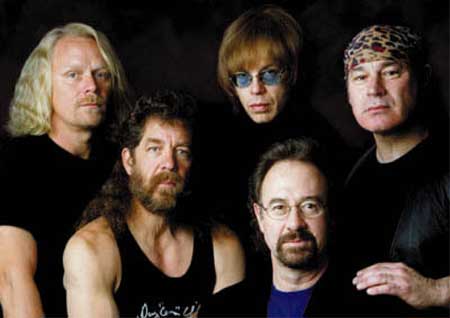
Creedence Clearwater Revival biography
Although
generally bracketed with the post-psychedelic wave of San Franciscan groups,
Creedence Clearwater Revival boasted one of the region's longest pedigrees. John
Fogerty (b. 28 May 1945, Berkeley, California, USA; lead guitar/vocals), Tom
Fogerty (b. 9 November 1941, Berkeley, California, USA, d. 6 September 1990,
Scottsdale, Arizona, USA; rhythm guitar/vocals), Stu Cook (b. 25 April 1945,
Oakland, California, USA; bass) and Doug Clifford (b. 24 April 1945, Oakland,
California, USA; drums) began performing together in 1959 while attending high
school. Initially known as the Blue Velvets, then Tommy Fogerty And The Blue
Velvets, the quartet became a popular attraction in the Bay Area suburb of El
Cerrito and as such completed several singles for the local independent
Orchestra. In 1964 they auditioned
for the more
prestigious Fantasy
Records, who signed them on the understanding
that they change their name
to the more topical Golliwogs to monopolize on the concurrent "British Invasion". Between 1965 and 1967, the
rechristened unit recorded seven singles, ranging from the Beatles-influenced
"Don't Tell Me No More Lies" to the compulsive "Fight Fire"
and "Walk Upon The Water", two superb garage band classics.
The quartet
turned fully professional in December 1967 and in doing so became known as Creedence Clearwater Revival (Creedence
for an acquaintance Credence Nuball and because of
its connotations of integrity;
Creedence
Clearwater Revival's second album release of 1969, Green River, consolidated
their new-found status and contained two highly successful singles, "Green
River" and "Bad Moon Rising", the latter of which topped the
Creedence
Clearwater Revival reached a commercial peak with July 1970's Cosmo's Factory.
The album included three gold singles, "Travelin'
Band", "Up Around The Bend" and "Lookin'
Out My Back Door", as well as an elongated reading of the Tamla/Motown Records classic "I Heard It Through The
Grapevine". The album defined the consummate Creedence
Clearwater Revival sound: tight, economical and reliant on an implicit mutual
understanding, and deservedly became the year's bestselling set. However,
relationships between the Fogerty brothers grew
increasingly strained, reflected in the standard of the disappointing Pendulum.
Although it featured their eighth gold single in "Have You Ever Seen The
Rain", the set lacked the overall intensity of its immediate predecessors,
a sparkle only occasionally rekindled in "Pagan Baby" and
"Molina".
Tom Fogerty left for a solo career in February 1971, but
although the remaining members continued to work as a trio, the band had lost
much of its impetus. Major tours of the
The rhythm
section followed low-key pursuits both independently and together, with Cook
enjoying most success in the late 80s as a member of Southern Pacific. Their
erstwhile leader began an erratic path dogged by legal and contractual
disputes, although he deservedly re-emerged in 1985 with the American
chart-topper Centrefield. Tom Fogerty
left the music business in the early 80s to work in real estate, but died in
1990 from tuberculosis. In 1993, Creedence Clearwater
Revival were inducted into the Rock And Roll Hall Of
Fame, although the animosity between Fogerty,
Clifford and Cook was clearly evident. The dispute flared up again in 1998 when
Clifford and Cook began touring as Creedence
Clearwater Revisited, with former Cars guitarist Elliot Easton and vocalist
John Tristano included in the line-up. A live album
was issued as John Fogerty attempted to stop Clifford
and Cook from using the Creedence name.