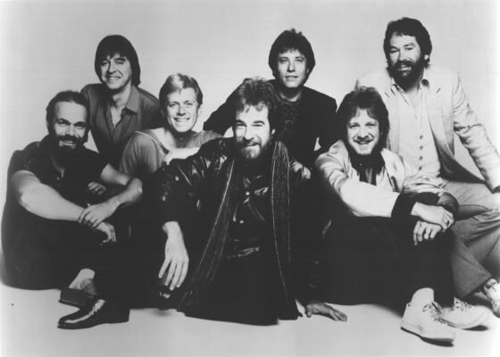
Chicago biography
Chicago is
one of the most successful rock bands in America and they are among the Top Ten
best-selling US musical groups of all time. With hits such as ‘Hard To Say I’m
Sorry’, ‘If You Leave Me Now’, ‘You’re the Inspiration’, and ‘Hard Habit to
Break’, Chicago may well be most widely identified from the Peter Cetera and
its era of radio-friendly power ballads, but its career spans further and wider
than their string of No. 1's.
Chicago
the band was formed, unsurprisingly enough, in Chicago the city, in Illinois,
and the largest in the American Midwest. Chicago saxophonist and founding
member Walter Parazaider cites the King of Swing,
Benny Goodman, as being his primary influence to start playing. Parazaider was nine and a clarinetist
to start with. After studying and practising for a number of years, he was a
classically proficient musician whose dream was to take his teacher’s place on
the Chicago Symphony. However, he also picked up the saxophone along the way,
as he “discovered that you could make a buck and get some girls playing a
saxophone in a rock 'n roll band.” Parazaider
enrolled in DePaul University, continuing his moonlighting gigs as well as
continuing to take classical clarinet classes.
Trumpeter
Lee Loughnane was also at DePaul, taking a teaching
degree. The addition of Loughnane to Missing Links
gave impetus to Parazaider’s vision of having a rock
band with a horn section. R&B bands already had this concept, such as James
Brown, and The Beatles paved the way with their ‘Revolver’ album. However, it
had never been tried out in a rock context with the horn section as an integral
part of the band’s sound.
They
needed more musicians, and the first to be approached was James Pankow, a recent transferee to DePaul from Quincy College
who played trombone. They still needed bass and keyboards to round out the
band. They thought they had found both in organist Robert Lamm.
Born in Brooklyn, New York, Lamm was asked if he
could fill in the bass lines on the organ pedals, and he lied, saying that he
could. Thus, The Big Thing was born, consisting of Parazaider
(sax), Seraphine (drums), Kath (guitarist), Loughnane (trumpet), Pankow
(trombone) and Lamm (organ and bass). Rehearsing in Parazaider’s basement, they learnt a repertoire of James
Brown and Wilson Pickett material. This was in 1967.
The Big
Thing became a regular on the Midwest club circuit, and on one fortuitous
evening, they opened for a band called the Exceptions, “the biggest club band
in the Midwest”, according to Pankow. The Big Thing
then had the audacity to nick the Exceptions’ bass player, Peter Cetera.
Cetera was
also a Chicago boy, taking up the accordion at age 10. He later switched to
bass and joined the Exceptions. Loughnane explains Cetera’s inclusion: “We needed a bass player at the time. Robert
was playing the bass pedals on the organ…there just wasn't enough bottom with
the bass pedals. You needed a real bass in the band. And we needed a tenor
voice…When Peter joined the band, that solidified our
vocals.”
The band
was now renamed Chicago Transit Authority, perhaps aptly named as the band was
asked to leave Chicago and relocate to LA, in late 1968. Kath, Pankow and especially Lamm were
writing large amounts of original material for the band.
In January
1969, the band went to New York to record their first album. Finding that they
had too much material, they suggested doing a double album, which CBS agreed to
on condition that they cut their royalties. ‘The Chicago Transit Authority’
(1969) was an audaciously ambitious double album, with audible influences from
the Beatles to Jimi Hendrix, from the soulful to the
rock-out bash, from howling guitar solos to smooth horn passages. It eventually
peaked on the Billboard chart at no. 17. Soon after the release, the band
changed its name to simply Chicago.
Simply
‘Chicago’ (1970) was also the name of their second double album, and was just
as ambitious as its predecessor. Perhaps the most adventurous recording so far
was the 13-minute ‘Ballet For A Girl In Buchannon’, penned by the classical-leaning Pankow. As a result of a broken jaw and some quiet writing
time, Cetera too contributed some material towards the album.
January 1971
came, and it was time to record their third double album, simply titled
‘Chicago III’ (1971) – Chicago were to use this system
of naming their future albums, because they felt that the songs simply spoke
for themselves. ‘Chicago III’ netted another cache of hit singles, including Cetera’s ‘Lowdown’ and Lamm’s
‘Free’.
After a
world tour, ‘Chicago V’ (1972) was recorded. It was also a milestone in that it
was the band’s first single disc album. Famous for Lamm’s
‘A Song for Richard and His Friends’, the song seemed to foreshadow Nixon’s
later impeachment for Watergate. The album marked a departure from the band’s
earlier extended instrumental jam-oramas, featuring
nine tightly crafted pop songs.
Just a
couple of months after the release of ‘Chicago VI’, the group gathered at Guercio’s ranch to record what would be their seventh
album. The original intention was to do a jazz record, hence ‘Italian From New York’, ‘Aire’, and
‘Devil's Sweet’ were written by Lamm, Seraphine, Parazaider, and Pankow. Cetera however never saw himself as a jazz
musician, which explains his diminished contribution songwriting-wise
on ‘Chicago VII’ (1974). Despite this, he did pen one of Chicago’s most famous
songs, ‘Wishing You Were Here’, which featured Carl and Dennis Wilson and Alan Jardine from the Beach Boys. The relationship between the
bands was so good that they embarked on a sold-out nationwide tour the
following summer. 1974 also saw the arrival of an eighth member, Brazilian
percussionist Laudir De Oliveira.
1975 was a
good year for Chicago. ‘Chicago VIII’ (1975) was released, and worldwide record
sales for this single year were 20 million copies. A greatest-hits compilation,
‘Chicago IX’ (1975) was released in November. June 1976 saw the release of
‘Chicago X’ (1976), with the massive, instantly recognisable hit ‘If You Leave
Me Now’, a song that barely made the final cut. ‘Chicago X’ won the band its
first platinum record, selling a million copies in three months, and ‘If You
Leave Me Now’ went to the top of the Billboard singles chart. The single won
them a Grammy for Best Pop Vocal Performance by a Duo, Group or Chorus, but
typecast the band into the saccharine ballad format that some members were
unhappy about (especially Kath and Lamm).
‘Chicago
XI’ was released in 1977, but tensions were mounting between producer Guercio and the band, resulting in a split. A few months
later, tragedy struck when Kath died of an accidental self-inflicted gunshot
wound. Devastated, the band tried to regroup by auditioning guitarists,
eventually hiring Donnie Dacus.
‘Chicago
17’ (1984) was the band’s best-seller. Hits like ‘Hard Habit to Break’ and
‘You’re The Inspiration’ took album sales to over six million. However, Peter
Cetera, writer of many of Chicago’s romantic ballads decided to leave in late
1985 to concentrate on his solo career. He was replaced by bassist and tenor
singer Jason Scheff, son of the legendary bass player
Jerry Scheff. The band also hired guitarist Dawayne Bailey, from Bob Seger’s
Silver Bullet band. ‘Chicago 18’ (1986) was a certified gold album, and after
an autumn tour to break in their new singer and guitarist, Chicago recorded
‘Chicago 19’ (1988). ‘Greatest Hits 1982-89’ (1989) and a tour with the Beach
Boys followed.
In 1997,
Chicago teamed up with the Hollywood Bowl Orchestra to perform an orchestral
arrangement of Pankow's rock epic ‘Ballet for a Girl
in Buchannon’. To commemorate their 30th anniversary,
they released the compilation ‘The Heart of Chicago 1967-1997’ (1997), which
had two new songs including the ballad ‘Here In My
Heart’.