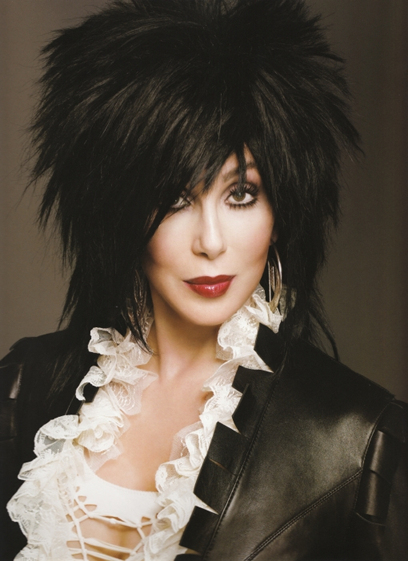
Cher biography
Cher has had three careers that place her indelibly in the public
consciousness, and two have been in association with her then-husband,
composer/producer/singer Salvatore "Sonny" Bono (February 16,
1935-January 8, 1998). She charted major hit records in the 1960s and 1970s,
working in idioms ranging from early- '60s girl group-style ballads to Jackie Deshannon folk-influenced pop, to adult contemporary pop in
the manner of later Dusty Springfield. She also embarked on an acting career,
initially in the late 1960s in association with her work as part of Sonny &
Cher but later on her own, which led to a series of
increasingly polished and compelling performances in Silkwood,
Mask and Moonstruck, for which she won the Academy Award for Best Actress.
Cherilyn
Sarkisian was born in California in 1946; she was 17
when she first met Salvatore "Sonny" Bono, a songwriter and protégé
of producer Phil Spector. Bono brought her to Spector, who used her as a backup singer and produced one
single by her, a novelty Beatles tribute record called "Ringo I Love You" issued under the name Bonnie Jo
Mason. It disappeared without a trace, but the couple were undaunted -- they
emerged as a duo, initially called Caesar & Cleo, later that year, and cut
"The Letter," "Do You Wanna
Dance" and "Love Is Strange."
Caesar & Cleo didn't trouble the chart compilers with any degree of
success, but late in 1964, Cher (then known as Cherilyn) was signed to Liberty Records' Imperial imprint,
and Bono came along as producer. A Spector-ish
version of "Dream Baby" managed to get airplay in Los Angeles,
becoming a local hit, and they suspected they were onto something. That same
month, Sonny & Cher, as they were now known,
signed to Reprise Records and released their first single, "Baby Don't
Go." The song became a major local hit in Los Angeles, after which the duo
jumped from Reprise to the Atco label, a division of
Atlantic Records. In April 1965 their first single, "Just You" was
released and rose to number 20 on the charts. The duo was on its way, and Cher also had Imperial Records after her for a second
single. The couple had seen the Byrds pioneer
commercial folk-rock with Bob Dylan's "Mr. Tambourine Man," and had
witnessed them performing another Dylan number, "All I Really Want to
Do" at a club in Los Angeles. The group intended to issue their own
recording of "All I Really Want to Do," but Cher,
with Sonny producing, beat them to the punch with her own recording of the
song.
She pursued a dual career for the next two years, cutting solo
recordings under Sonny's guidance that regularly charted, and duets with her
husband for Atco. A month after "All I Really
Want to Do," they released "I Got You Babe," which was one of
the biggest-selling and most beloved pop/rock hits of the mid-'60s, and the
couple's signature tune across two eras of success. Cher's
solo career ended up slightly overshadowed by her work with Sonny & Cher, but at the time she was fully competitive on her own
terms -- her first LP reached the Billboard Top 20 and was on the albums charts
for six months. "Bang Bang (My Baby Shot Me
Down)" was another hit, a million-seller that made number three in America
and England, and she made the Top Ten once more with her 1967 single "You
Better Sit Down Kids." The latter song, written by Bono (and which was
also a hit for Glen Campbell), dealt with divorce, an unusual subject for a
1960s pop record, and was one of a series of releases on which Cher's music broached difficult areas -- others were
"I Feel Something's in the Air," which dealt with unwanted pregnancy,
and "Mama (When My Dollies Have Babies)," both written by Bono.
Cher's solo career at
Imperial, which had created some political problems for the couple at Atlantic,
ended with the lapsing of her contract in 1967, and she moved to Atlantic. Ironically,
it was this move that contributed the unhappy reversal of the couple's fortunes
at the end of the decade.
By the end of the 1960s, Sonny & Cher were
no longer selling records. A series of commercial missteps, coupled with a
change in public taste, had sharply curtailed their sales, and a pair of movies
(Good Times, Chastity) had lost millions.
Coupled with the presentation of a bill from the Internal Revenue
Service for $200,000 in back taxes, these events left the couple in dire
financial straights at the end of the 1960s. They were forced to play club
dates, opening for artists like Pat Boone, and it was there that their second
career, and a second career for Cher, took shape. A
new contract with Decca Records in 1971, coupled with a chance at a summer
replacement gig on the CBS television network, brought them a second chance at
success.
The try-out on television was a success, as the couple proved to be as
funny as they were musically diverse. It took a little longer to find a new
formula for Cher's music -- her initial single on
Decca's Kapp label, "Classified 1A,"
written by Bono, was a failure; a serious song dealing with a girl's feelings
for a boyfriend killed in Vietnam; it was topical in all the wrong ways to
become a pop chart success. Producer Snuff Garrett was recruited to work with
her, and he found a series of songs that were perfect for Cher's
maturing talent.
"Gypsies, Tramps and Thieves," a conscious attempt to emulate
Springfield's "Son of a Preacher Man" (which also recalled Cher's own "Bang Bang")
was released late in 1971 and became a number one hit and a million-seller. To
some listeners, "Gypsies, Tramps and Thieves" was the epitome of schlocky pop/rock, but the song's subject matter, unusual
tempo changes, and an incredibly memorable chorus-hook became a vehicle for a
transcendent performance by the singer, marking Cher's
maturation as an artist (the B-side, "I Hate to Sleep Alone," written
by Peggy Clinger of the Clinger Sisters, curiously enough, managed to recall
Sonny's Spector-influenced productions from the
Imperial years). A follow-up album, featuring her covers of contemporary hits
such as "Fire and Rain," sold well also, and her next single,
"The Way of Love," a revival of a mid-'60s Kathy Kirby hit,
solidified the image of a new, more confident and powerful Cher.
And the debut of the couple's regular network variety series on CBS in January
1972 brought them back to the center of American and
international popular culture in a more mature, wittier guise, and one that
concentrated much more on Cher as a personality.
Her 1960s music ran the gamut from Spector-style
miniature teen-pop symphonies to covers of contemporary adult pop ("It's
Not Unusual") and folk-rock, all cut under Bono's
guidance. Her voice wasn't very rich or powerful, but it was expressive and
surrounded by Bono's radiant Spector
creations, and she could put over an almost inappropriately cheerful sounding
version of "The Bells of Rhymney" or "Blowin'
in the Wind." By contrast, her early- 1970s material, solo or with Sonny,
had a more adult point of view and personality. {"Gypsies, Tramps and
Thieves"} and the later number one solo hits "Half-Breed" and
"Dark Lady" were dramatic, highly intense performances, almost as
much "acted" as sung, and very different from her 1960s output.
In 1974, it was revealed that the couple's marriage was coming to an
end. Ironically, Cher came out of this split more
secure than her husband, despite his having guided her career for a decade and
having all of the real training in the entertainment business. She embarked on
an acting career, even as she continued to make headlines for her romantic
exploits, including an affair with (and two marriages to) Gregg Allman. She became a far better actress than she was a
singer, first revealed in Mike Nichols' Silkwood
(1983) and then in Peter Bogdanovich's Mask (1985)
and George Miller's The Witches of Eastwick (1987). Her
acting peers caught on to the worth of her work in time for an Academy Award
for Best Actress for her performance in Norman Jewison's
1987 romantic comedy Moonstruck.
Since the mid-'70s, Cher has been known more
for her acting than for her music, although she has continued to record for
numerous labels, including Columbia, and in 1998 scored an international
chart-topping smash with the club-friendly single "Believe." She is,
by Garrett's analysis, more of a stylist than a singer, and almost as much a
personality as an actress, almost a modern-day Helen Morgan (Showboat, etc.)
with better luck in life and career.