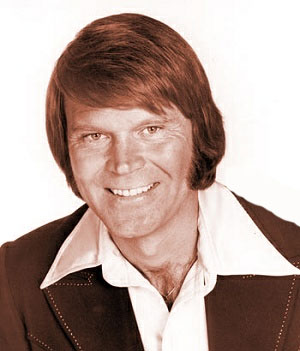
Glen Campbell biography
Glen Campbell was born April 22, 1936, in
Delight, Ark.,
as the seventh son in a family of 12 children. He came from a musical family
(that made its living as sharecroppers) and began his career with his uncle's
Dick Bills Band in 1954, before
forming
Glen Campbell and the Western Wranglers four years later. By the end of the '50s, he had moved to Los Angeles
where he became a renowned session player and one of the finest guitarists in Hollywood. His sessions
included work for the Mamas and the Papas, Ricky Nelson, Frank Sinatra, Merle
Haggard and Bobby Darin, among others.
After briefly joining the Champs -- an
instrumental band best known for the hit "Tequila" -- he released a
solo single, "Too Late to Worry, Too Blue to Cry," which crept into
the charts. He also briefly replaced Brian Wilson on the Beach Boys' tours. However,
Campbell's
period as a Beach Boy was short-lived, and he soon returned to session work and
recording, even enjoying a minor hit with Buffy
Sainte-Marie's "The Universal Soldier."
By 1967, Capitol Records were seriously
promoting Campbell
as an artist in his own right. Having already spent five years on the label,
the breakthrough came with an accomplished version of John Hartford's
"Gentle on My Mind," which won a Grammy in 1967. (It only reached No.
30 on the Billboard country singles chart.) In 1968, he won the CMA's
male vocalist and entertainer of the year awards. A trilogy of hits written by
Jimmy Webb -- "By the Time I Get to Phoenix," "Wichita
Lineman" and "Galveston" -- kept Campbell on the charts through
the close of the 1960s. Other memorable hits from that era include "I Wanna Live" and "Dreams of the Everyday
Housewife."
By this stage of his career, Campbell was actively
pursuing television work. He hosted the TV variety series The Glen Campbell
Goodtime Hour from 1968 to 1972 and starred with John Wayne in the 1969
movie True Grit. He also paired with Bobbie Gentry for the hit duets of
the Everly Brothers' "Let It Be Me" and
"All I Have to Do Is Dream."
For a few years in the early 1970s, his
chart momentum cooled, until the Urban Cowboy craze catapulted
"Rhinestone Cowboy" to No. 1 in 1975. The anthem became his signature
hit, and he reached No. 1 again in 1977 with "Southern Nights." Throughout
the 1980s, he notched a handful of Top 10 hits but struggled with drug
addictions, three divorces and a scandalous romance with Tanya Tucker, who was
then in her early 20s.
Campbell
published Rhinestone Cowboy: An Autobiography in 1994 and has recorded
several gospel albums. He was arrested for DUI in 2003, after a hit-and-run
traffic accident in Phoenix
where he now lives.