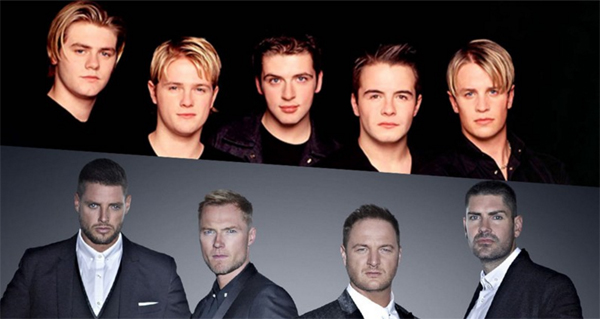
B O Y Z O N E biographhy
Boyzone was Europe's most
successful boy bands during the second half of the 1990s. Comprised of five
Irish vocalists and funded by music manager Louis Walsh, the group embraced a
similar style of pop music as Take That, whose breakup
in 1996 created a void that Boyzone happily filled.
By combining boyish charm
with slick songwriting (much of which was co-written
by the bandmates themselves), the singers found
enormous success throughout the U.K., where 16 of their first 17 singles became
Top Five hits. Six of those songs made it to number one, establishing Boyzone
as the first Irish group to top the British charts so regularly, and bandmate Stephen Gately garnered additional headlines in
1999 by announcing his homosexuality, making Boyzone one of the only boy bands
to include an openly gay member. The group didn't fare nearly as well in
America, where acts like *NSYNC and the Backstreet Boys reigned supreme, but Boyzone's
success in Europe was nearly unparalleled during the group's heyday.
Boyzone was founded in
1993 by Louis Walsh, an aspiring music mogul who - like Maurice Starr and Lou
Pearlman - formed, funded, and managed the group from day one. Over 300
vocalists auditioned for Walsh's project, including future actor Colin Farrell,
but the competition was ultimately narrowed down to five males: Mikey Graham, Stephen
Gately, Shane Lynch, Keith Duffy, and lead vocalist Ronan Keating. The quintet
initially honed its sound by performing covers of '70s pop tunes, including Detroit
Spinners' "Working My Way Back to You," which became a number three
hit on the Irish charts, and the Osmonds' "Love Me for a Reason," Boyzone's
first single to chart in the U.K. When it came time to write original material,
however, the group hired Ray Hedges of Take That to lend his songwriting assistance.
With Hedges' help, Boyzone
filled their debut effort, Said and Done, with five
high-charting singles. Released in 1995, the album eventually went triple-platinum
in the U.K. and paved the way for A Different Beast, which arrived in 1998 and
spawned three additional singles (including a pair of number one hits). Similar
groups were concurrently reigning the airwaves in
America, but Boyzone rarely concentrated their efforts overseas, focusing
instead on the fan bases that had sprung up in Ireland, New Zealand, Norway,
Austria, and other European countries. By the time Where We Belong arrived in
1998, the boys had become certifiable superstars at home, selling more than
three million copies of their new album in the U.K. and sending Where We Belong
to the top of the charts in five countries.
As the decade drew to a
close, Boyzone released a popular greatest-hits album, By Request, and
continued touring the continent. Meanwhile, Ronan Keating jumpstarted his solo
career by releasing "When You Say Nothing at All" in June 1999, the
same month that Stephen Gately announced he was gay. Attention continued to
swirl around the band, but Boyzone nevertheless called it quits after a final
performance in January 2000, citing intra-band tension as the reason for the
split. Both Keating and Gately gained additional recognition as solo artists
during the following years, while Duffy pursued an acting career.
In light of Take That's successful reunion in 2006, Boyzone re-formed two
years later. A 29-city tour proved to be fairly lucrative, as did the release
of Back Again...No Matter What, a compilation album that scored another Top
Five hit with the new song "Love You Anyway." Additional new material
was recorded for a proper studio album, but Stephen Gately died before the
album's release, passing away in October 2009 due to an acute pulmonary edema. Carrying on as a four-piece, the band dedicated
their 2010 release Brother to Gately and subsequently toured the U.K. and
Ireland. In 2013 they marked their 20th anniversary with a nationwide tour
which spanned huge venues such as Dublin and London's O2 Arenas and
Birmingham's NEC.