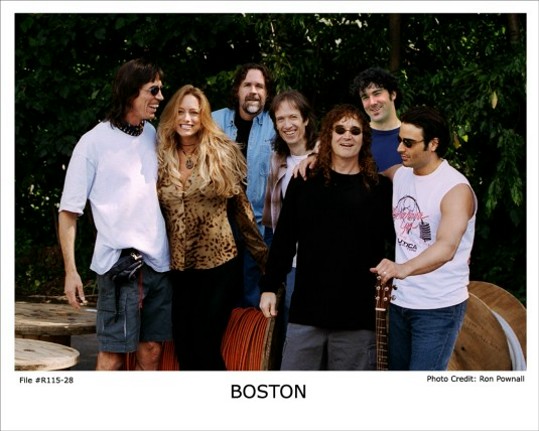
The arena rock group behind one of the fastest-selling debut albums in
history, Boston
was essentially the vehicle of studio wizard Tom Scholz,
born March 10, 1947, in
At the same time, Scholz set about
constructing his own 12-track recording studio in the basement of his home,
where the group -- now dubbed Boston
and including Goudreau, vocalist Brad Delp, bassist Fran Sheehan, and drummer John
"Sib" Hashian -- recorded the demos that
earned them a contract with Epic in 1975. Although some recording and overdubs
were later done in Los Angeles, the 1976 release of Boston consisted largely of
Scholz's original basement tapes; spawning three hit
singles ("More Than a Feeling," "Long Time," and
"Peace of Mind"), the LP shot immediately to the top of the charts,
and remained the best-selling pop debut effort in history before it was
supplanted by Whitney
Houston's first album in 1986.
Despite the record's overwhelming success, Scholz
spent over two years working on the follow-up, 1978's number one hit Don't Look
Back; a perfectionist, he only then released the album because of intense label
pressure for product. Unsatisfied with the results, he swore to produce the
next album at his own pace; as a result, the chart-topping Third Stage did not
appear until 1986, at which time only Scholz and Delp remained from the original lineup.
Scholz spent the next several years in the courtroom:
first, he was sued by Goudreau, who alleged that Scholz
had damaged his solo recording career (they settled out of court); next, he won
a seven-year battle against Epic, which claimed Boston
had reneged on its contract by taking so long between releases. When the band
resurfaced again in 1994 with Walk On, Scholz was the
lone remaining member; Delp and Goudreau had reunited in 1992 as RTZ, releasing the album
Return to Zero. Unlike previous returns, Walk On was a notable failure. Radio
and MTV ignored any attempts at singles or videos, and the minimalist approach
taken by the popular alternative artists of the era made the crystalline
production and lengthy recording time seem like an egotistical exercise.
Compounding the problem was the poor songwriting,
which could no longer be hidden with glossy production techniques. Scholz still hit the road to support it, but upon his
return to the studio he knew he had to approach his situation differently.
Taking another eight years to work on the next record, he targeted the
Internet crowd first by releasing a single to www.MP3.com in the summer of
2002. The track became the site's number one download, and word of their new
album spread quickly. Secondly, Scholz set his
lyrical sights on political targets, going so far as to title the record
Corporate America as he emphasized his disdain for the system he had been a
vital part of at one time. Releasing the record in the fall of that year, Boston
didn't even have another member anymore and the following tour was postponed
while Scholtz searched for accompaniment.
In addition to his fame as a musician, Scholz
also found success as an inventor and businessman. In 1981, he formed Scholz Research & Design, Inc., a company founded to
create high-tech music equipment. After first developing the Power Soak, a
volume-control device, SR&D introduced the Rockman,
a small and inexpensive guitar amplifier with headphones. The Rockman proved phenomenally popular with other musicians,
and the capital generated from its sales helped fund Scholz's
further musical ambitions.