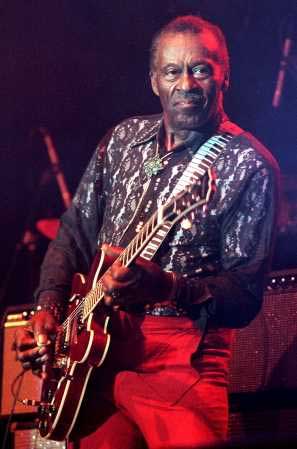
Chuck Berry biography
b. Charles Edward Anderson Berry, 18 October 1926, San
Jose, California, USA (although Berry
states that he was born in St. Louis,
Missouri). A seminal figure in
the evolution of rock 'n' roll, Chuck Berry's influence as songwriter and
guitarist is incalculable. His cogent songs captured adolescent life, yet the
artist was 30 years old when he commenced recording. Introduced to music as a
child, Berry
learned guitar while in his teens, but this period was blighted by a three-year
spell in Algoa Reformatory following a conviction for
armed robbery. On his release Berry undertook
several blue-collar jobs while pursuing part-time spots in St. Louis bar bands. Inspired by Carl Hogan,
guitarist in Louis Jordan's Timpani Five, and Charlie Christian, he continued
to hone his craft and in 1951 purchased a tape recorder to capture ideas for
compositions. The following year Berry
joined Johnnie Johnson (piano) and Ebby Hardy (drums)
in the house band at the Cosmopolitan Club. Over the ensuing months the trio
became a popular attraction, playing a mixture of R&B, country/hillbilly
songs and standards, particularly those of Nat "King" Cole, on whom Berry modelled his cool
vocal style. The guitarist also fronted his own group, the Chuck Berry Combo,
at the rival Crank Club, altering his name to spare his father's embarrassment at such worldly pursuits.
In 1955, during a chance visit to Chicago,
Berry met bluesman Muddy Waters,
who advised the young singer to approach the Chess Records label.
Berry's demo
of "Ida May", was sufficient to win a
recording contract and the composition, retitled
"Maybellene", duly became his debut single.
This ebullient performance was a runaway success, topping the R&B chart and
reaching number 5 on the US
pop listings. Its lustre was partially clouded by a conspiratorial publishing
credit that required Berry
to share the rights with Russ Fratto and disc jockey
Alan Freed, in deference to his repeated airplay. This situation remained
unresolved until 1986. Berry
enjoyed further US R&B hits with "Thirty Days" and "No Money
Down", but it was his third recording session that proved even more
productive, producing a stream of classics, "Roll Over Beethoven",
"Too Much Monkey Business" and "Brown-Eyed Handsome Man". The
artist's subsequent releases read like a lexicon of pop history - "School
Days" (a second R&B number 1), "Rock And Roll Music" (all
1957), "Sweet Little Sixteen", "Reelin'
And Rockin", "Johnny B. Goode",
"Around And Around", "Memphis Tennessee" (all 1958),
"Little Queenie", "Back In The
USA", "Let It Rock" (all 1959), "Bye Bye
Johnny", "Jaguar And Thunderbird" (all 1960),
"Nadine", "You Never Can Tell", "No Particular Place
To Go" and "The Promised Land" (all 1964) are but a handful of
the peerless songs written and recorded during this prolific period. In common
with contemporary artists, Berry
drew from both country and R&B music, but his sharp, often piquant, lyrics,
clarified by the singer's clear diction, introduced a new discipline to the
genre. Such incomparable performances not only defined rock 'n' roll, they
provided a crucial template for successive generations.
Both the Beatles and Rolling Stones acknowledged their debt to Berry. The former
recorded two of his compositions, taking one, "Roll Over Beethoven",
into the US
charts, while the latter drew from his empirical catalogue on many occasions. This
included "Come On", their debut single, "Little Queenie", "You Can't Catch Me" and
"Around And Around', as well as non-Berry songs that nonetheless aped his
approach. The Stones" readings of "Route 66", "Down The
Road Apiece" and "Confessin' The
Blues" were indebted to their mentor's versions, while Keith Richards'
rhythmic, propulsive guitar figures drew from Berry's style. Elsewhere, the Beach Boys
rewrote "Sweet Little Sixteen" as "Surfin'
USA" to attain their first million-seller, while countless other groups
scrambled to record his songs, inspired by their unique combination of
immediacy and longevity.
Between 1955 and 1960, Berry
seemed unassailable. He enjoyed a run of 17 R&B Top 20 entries, appeared in
the movies Go, Johnny, Go!, Rock Rock Rock and Jazz On A Summer's Day, the last of which
documented the artist's performance at the 1958 Newport Jazz Festival, where he
demonstrated the famed "duckwalk" to a
bemused audience. However, personal impropriety undermined Berry's personal and professional life when,
on 28 October 1961, he was convicted under the Mann Act of "transporting
an underage girl across state lines for immoral purposes". Berry served 20 months in prison, emerging in October
1963 just as "Memphis,
Tennessee", recorded in
1958, was providing him with his first UK Top 10 hit. He wrote several
compositions during his incarceration, including "Nadine", "No
Particular Place To Go", "You Never Can Tell" and "The
Promised Land", each of which eventually reached the UK Top 30. Such chart
success soon waned as the R&B bubble burst, and in 1966 Berry sought to regenerate his career by
moving from Chess to Mercury Records. However, an ill-advised Golden Hits set
merely featured re-recordings of old material, while attempts to secure a
contemporary image on Live At The Fillmore Auditorium (recorded with the Steve
Miller Band) and Concerto In B. Goode proved equally unsatisfactory.
He returned to Chess Records in 1969 and immediately re-established his
craft with the powerful "Tulane". Back Home and San Francisco Dues
were cohesive selections and in-concert appearances showed a renewed purpose. Indeed,
a UK performance at the 1972
Manchester Arts Festival not only provided half
of Berry's
London Sessions album, but also his biggest-ever hit. "My
Ding-A-Ling", a mildly ribald double entendre first recorded by Dave
Bartholomew, topped both the US
and UK
charts, a paradox in the light of his own far superior compositions, which achieved
lesser commercial plaudits. It was his last major hit, and despite several new
recordings, including Rockit, a much-touted release
on Atco Records, Berry became increasingly confined to the
revival circuit. He gained an uncomfortable reputation as a hard, shrewd
businessman and disinterested performer, backed by pick-up bands with whom he
refused to rehearse. Tales abound within the rock fraternity of Berry's refusal to tell
the band which song he was about to launch into. Pauses and changes would come
about by the musicians watching Berry
closely for an often disguised signal. Berry
has insisted for years upon pre-payment of his fee, usually in cash, and he
will only perform an encore after a further negotiation for extra payment.
Berry's continued legal
entanglements resurfaced in 1979 when he was sentenced to a third term of
imprisonment following a conviction for income tax evasion. Upon release he
embarked on a punishing world tour, but the subsequent decade proved largely
unproductive musically and no new recordings were undertaken. In 1986, the
artist celebrated his 60th birthday with gala performances in St.
Louis and New York.
Keith Richards appeared at the former, although relations between the two men
were strained, as evinced in the resultant documentary Hail! Hail! Rock 'N' Roll, which provided an overview of Berry's career. Berry was inducted into the Rock And Roll
Hall Of Fame the same year. Sadly, the 90s began with further controversy and
reports of indecent behaviour at the singer's Berry Park
centre. Although the incident served to undermine the individual, Berry's stature as an
essential figure in the evolution of popular music cannot be overestimated.